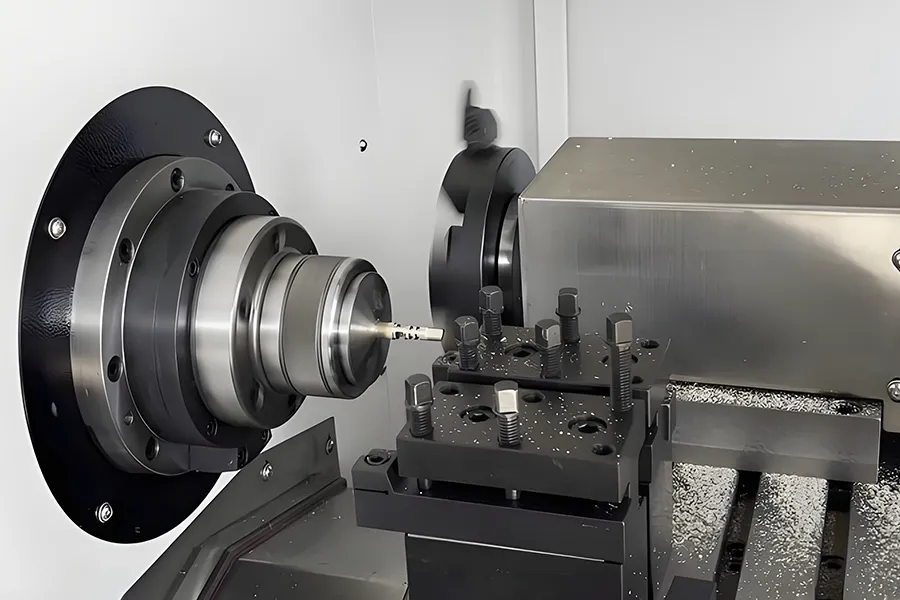
In today’s increasingly competitive manufacturing industry, shorter delivery times, higher precision, and lower costs have become fundamental requirements for all sectors. Traditional machining methods are no longer sufficient to meet the demands for high-efficiency, large-scale, and highly stable production. CNC machine tools are the core equipment for enterprises to achieve efficiency improvements, reduce reliance on manual labor, and enhance machining consistency.
1. Reducing Labor Costs and Avoiding Wasted Time Through Automated Machining
Traditional machining heavily relies on the skill level of technical workers, resulting in inconsistent efficiency and frequent machining errors. The advantage of CNC machine tools lies in—
They require only one programming session for batch and repeated production with consistent precision.
Enterprises can maximize the value of automation through the following methods:
1.1 Adopting Standardized Machining Programs
A stable program can be used for machining hundreds or even thousands of parts, reducing debugging and manual intervention.
1.2 Using Automatic Tool Changer (ATC) Systems
Automatic tool changing during multiple machining operations saves manual reloading, directly reducing time by 30%–50%.
1.3 Configuring an Automated Loading and Unloading System
Equipped with robotic arms or a material handling unit, continuous operation is possible, increasing machine tool uptime and enabling continuous production even when unmanned. These methods allow companies to “free up their hands,” dedicating more personnel to higher-value roles.
2. Reducing Waste and Rework Through High-Precision Machining
Machining errors can lead to material waste, rework, customer complaints, and delivery delays. CNC machine tools can significantly reduce these risks through precise control.
CNC machine tools improve quality by:
- Micron-level feed and positioning accuracy;
- Automatic compensation systems reduce the impact of thermal drift;
- High stability ensures consistency across all products;
- Tool wear monitoring prevents batch scrap due to tool failure;
- Reducing scrap rates not only saves costs but also enhances corporate reputation and delivery performance.
3. Optimizing Machining Paths to Improve Cutting Efficiency
The machining efficiency of CNC machine tools largely depends on the rationality of the machining strategy.
Companies can improve cutting efficiency through the following methods:
3.1 Optimizing Tool Paths
Reducing invalid paths and idling distances can shorten machining time by 10%–25%.
3.2 Employ High-Speed Cutting (HSC) Strategy
Increase spindle speed and cutting speed, suitable for materials such as aluminum alloys and mold steel.
3.3 Use High-Efficiency Tools
Selecting more wear-resistant tools can extend tool life, and multi-bladed tools can accelerate cutting.
3.4 Utilize CAM Software Simulation
Predict collisions and verify trajectories in advance, reducing on-site trial cutting time and wear.
Through path optimization and tool strategy improvement, enterprises can significantly improve production efficiency and product consistency.
4. Implement Machine Tool Linkage and Digital Management
For large-scale manufacturing enterprises, improving the efficiency of a single machine tool is no longer sufficient; more importantly, it is crucial for collaboration and data connectivity between machine tools.
Enterprises can achieve digital efficiency enhancement through the following methods:
4.1 Adopt Machine Execution System (MES/SCADA)
View machine tool status, capacity utilization, and downtime causes in real time, helping managers make faster decisions.
4.2 Data-Driven Machining Optimization
Analyze tool life, machining cycle time, and abnormal downtime based on historical data to optimize production planning.
4.3 Remote Monitoring and Predictive Maintenance
Reduce downtime caused by unexpected failures and increase machine tool uptime.
Digitalization is one of the key paths for manufacturing enterprises to transform towards high efficiency and low cost.
5. Improving Overall Team Efficiency Through Training and Process Standardization
High-end equipment must be paired with an efficient operating team to realize its maximum value. Enterprises can improve team efficiency in the following ways:
- Establish unified programming standards;
- Set tool management standards;
- Develop equipment maintenance plans;
- Provide professional training for operators;
- Implement “efficiency improvement” projects;
When equipment and team capabilities are matched, the overall production efficiency of the enterprise can achieve exponential growth.
6. Choosing the Right CNC Machine Tool is the First Step to Improving Efficiency
To improve efficiency, equipment selection is crucial.
When choosing a CNC machine tool, the following should be considered:
- Whether it meets your product precision requirements;
- Whether it supports multi-process composite machining;
- Whether the tool magazine capacity can handle complex tasks;
- Whether it supports automation expansion (robotic arms, material hoppers);
- Brand after-sales service, maintenance, and software compatibility;
The right machine tool can increase processing efficiency by 30%~200%, while the wrong selection can double the cost.
Conclusion
CNC machine tools are not merely processing equipment; they are key tools for improving enterprise efficiency, reducing costs, shortening delivery times, and enhancing stability. Through automated machining, high-precision control, optimized machining strategies, digital management, and standardized processes, enterprises can significantly improve overall production efficiency.
For manufacturing enterprises, investing in a CNC machine tool is not only a technological upgrade but also an enhancement of their business competitiveness.