Explaining things on the internet can be just as challenging as volunteering to teach in a remote area.
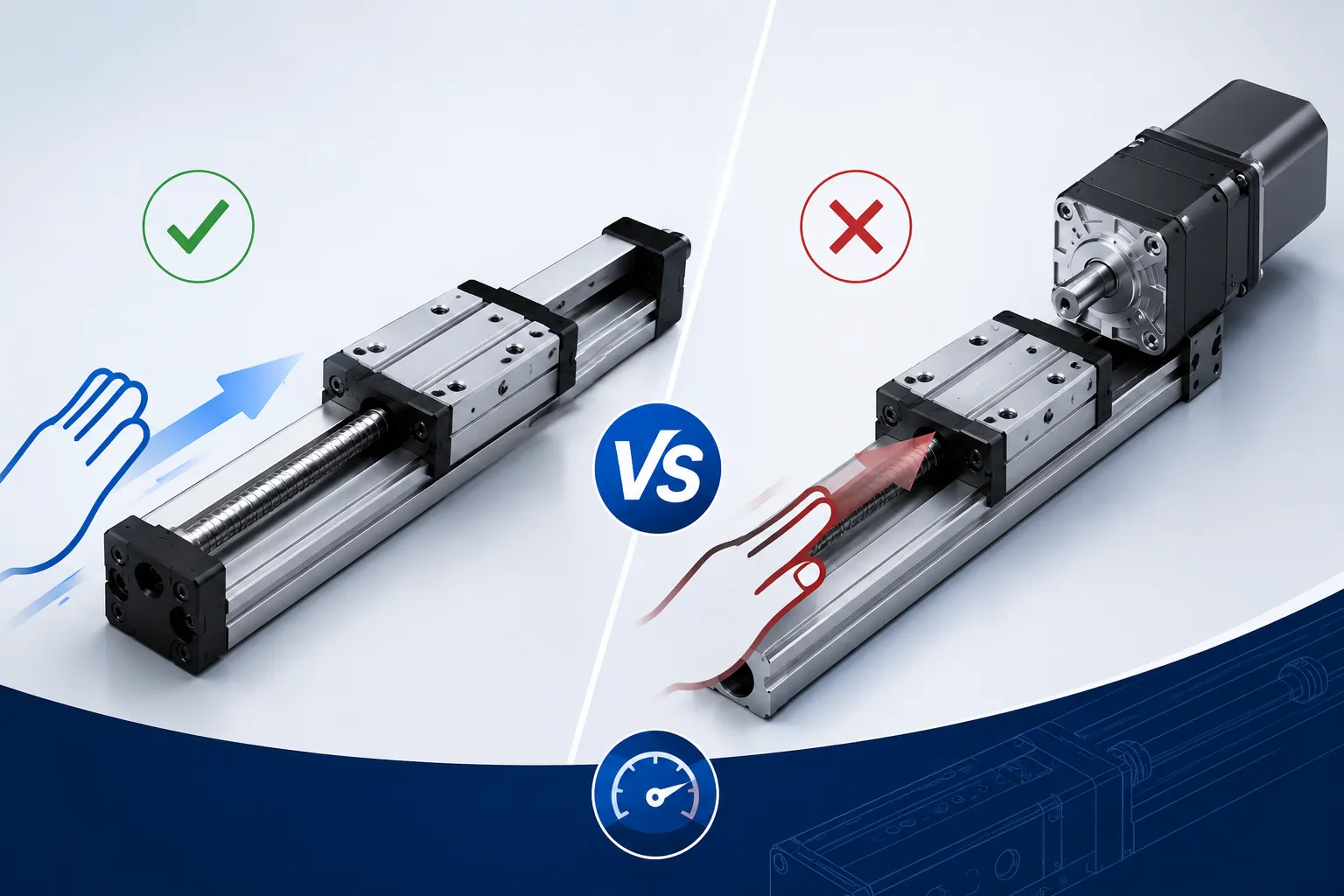
Sometimes, even when you’ve explained something clearly, someone will inevitably pop up to question it: “Is there a problem with this linear module? Why won’t it budge when I push it?”
In reality, this isn’t an equipment malfunction; it’s simply because a gearbox (or speed reducer) has been installed on the module. Let’s take a look at what it actually does.
1. What is a gearbox?
A gearbox (or speed reducer) is a common mechanical transmission device. As the name implies, its primary functions are:
- Reducing speed: It lowers the motor’s high rotational speed to a level suitable for the module’s operation.
- Amplifying torque: While reducing speed, it outputs greater thrust or pulling force, allowing the module to handle heavier loads.
It works just like a car transmission—low gears move slowly but provide more power for climbing hills.
2. Why does it feel “harder” to push?
When a gearbox is installed between the linear module and the motor, the meshing of gears creates a certain amount of resistance. This means that when you try to push it manually, you have to overcome more friction and structural resistance; furthermore, the system is designed to resist easy movement to ensure high-precision positioning and stability. So, when critics complain that it “won’t budge,” it actually proves that the gearbox is doing its job correctly.
3. The value of a gearbox
In applications involving linear modules and the “seventh axis” of robots, the inclusion of a gearbox offers several significant advantages:
- More precise positioning: Stable low-speed operation makes it ideal for precision tasks.
- Greater load capacity: A small motor paired with a gearbox can handle heavier material-handling tasks.
- Increased system durability: It prevents frequent motor overloads, extending the lifespan of the entire unit.
In short, the extra effort required to push the unit is a trade-off for superior performance and greater reliability.
Summary
So, the next time someone online questions whether a linear module is of poor quality because it’s hard to push, remember:
This isn’t a defect; it’s a characteristic of the gearbox.
It is precisely because of the gearbox that the linear module can deliver greater power and stability in real-world applications.
CSK Motions is committed to matching the right linear modules and transmission solutions to specific application scenarios. Professional design and component selection are far more important than how easily the unit moves when pushed by hand.