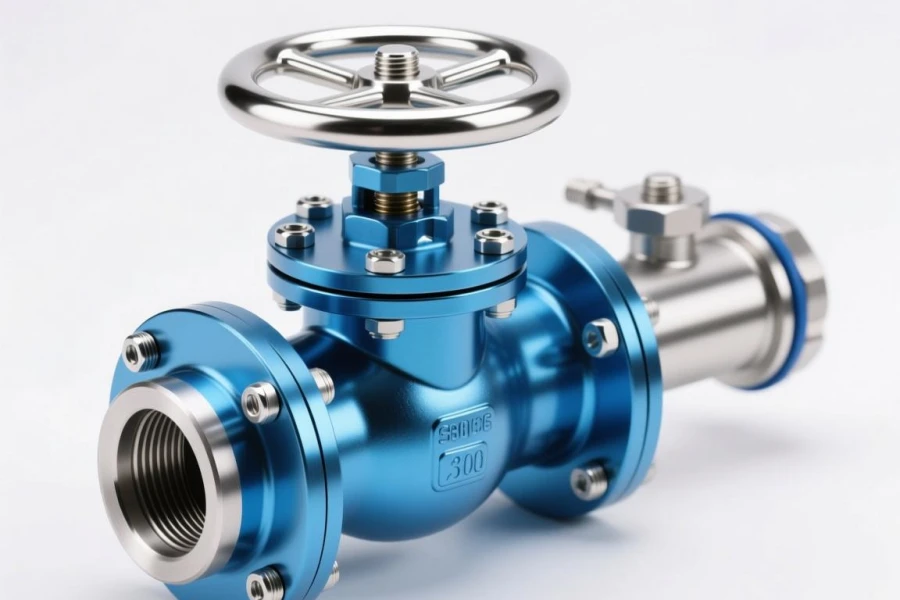
When it comes to equipment assembly and fluid control systems, the industrial valve is a core component that cannot be ignored. So, what does an industrial valve do exactly? In short, its primary functions include controlling the on-off state, flow direction, flow rate, and pressure of fluids, while also providing safety protection for the entire system. Across industries like petrochemicals, power generation, metallurgy, water treatment, food and beverage, and pharmaceuticals, any pipeline system that transports gases or liquids relies on various types of industrial valves to operate smoothly.
What Is the Role of an Industrial Valve?
An industrial valve is far more than just a simple “switch”—it acts as the command center of a fluid system. Different types of them serve distinct purposes: for example, ball valves are often used for quick on-off operations, gate valves are suitable for long-term open scenarios, butterfly valves are compact and offer excellent adjustability, check valves prevent fluid backflow, and safety valves release pressure timely to avoid overpressure in the system.
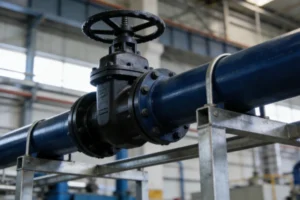
As industries raise higher requirements for system operational stability, energy efficiency, and maintenance cycles, the sealing reliability of an industrial valve has become an increasingly critical concern. When selecting, assembling, or maintaining industrial valves, we shouldn’t just focus on their structural design—we also need to consider a key question: is their sealing performance stable enough?
Common Industrial Valve Types and Typical Failures
Main Types and Characteristics
- Ball Valves (A Type of Industrial Valve): Primarily used for rapid on-off control. Their structure includes stems, balls, seats, and seals. Common sealing challenges here involve micro-loosening between the stem and housing, and gap wear at the ball’s axial fitting points.
- Gate Valves (A Type of Industrial Valve): Suitable for shut-off applications. They have a relatively simple structure but are operated frequently, so their flange sealing surfaces are prone to loosening from repeated opening and closing.
- Butterfly Valves (A Type of Industrial Valve): Lightweight and ideal for large-diameter scenarios. Their valve shafts require high rotational precision, so the bearing fitting areas are likely to experience wear and loosening.
- Check Valves (A Type of Industrial Valve): Designed to prevent fluid backflow. The valve disc’s return relies on fluid kinetic energy, so the sealing surfaces have strict requirements. Additionally, their pipe connections are mostly threaded, leading to higher sealing risks.
Typical Failures
From on-site experience, a significant portion of industrial valve failures stem from sealing failure. Issues like flange gasket compression deformation, thread loosening due to vibration, and micro-motion wear at fitting gaps may seem minor, but they can lead to leaks—causing system fluctuations at best, and compromising production safety or even triggering accidents at worst.
Many well-designed industrial valves still require frequent repairs after a period of operation. The root cause is often not structural defects, but insufficient consideration of sealing materials, methods, and processes. This is why more and more valve manufacturers and equipment maintenance units are emphasizing the use of sealing adhesives (such as thread lockers and anaerobic sealants) instead of traditional mechanical connections and gaskets. These adhesive solutions perform more stably in terms of pressure resistance, anti-loosening, corrosion resistance, and shock resistance, adapting better to modern operating conditions.
Sealing Solutions for Different Industrial Valve Structures
Anti-Loosening Solutions for Industrial Valve Stem Connections
Metal threads are a common connection method in industrial valve assemblies. However, long-term operation in high-temperature, high-vibration environments can cause micro-loosening between threads, creating leak points.
For maintaining valves like pressure control valves (a type of industrial valve) and plug valves, a thread locker is recommended. This product offers excellent anti-loosening and shock-resistant properties, suitable for various metal threads (such as stainless steel, aluminum, and electroplated surfaces). It can also tolerate mild industrial oil contamination, ensuring stable locking even in slightly polluted environments. Its removable feature also makes it suitable for bolt connections that require later maintenance.
Flange Sealing Improvement for Industrial Gate Valves
For rigid metal flange connections in industrial gate valves and check valves, traditional gaskets may experience compression fatigue or deformation under high-temperature or high-pressure conditions—due to thermal expansion/contraction or medium impact—leading to leaks.
In such scenarios, a flexible flange sealant works effectively. This is an anaerobic adhesive that can be used directly on slightly oily surfaces, curing to form a pressure-resistant sealing film. It is particularly suitable for planar sealing of machined metal surfaces. Using this sealant not only improves sealing performance but also significantly reduces gasket inventory and repair frequency.
Gap Repair Between Industrial Valve Stem and Housing
In industrial valves involving rotational motion (such as ball valves, butterfly valves, and multi-port valves), the fitting precision between the valve shaft and housing is crucial. Any gaps or micro-motion can cause uneven wear, noise, or even damage to the sealing surfaces.
A high-strength cylindrical retaining adhesive is recommended for this issue. This product can fill fitting gaps, enhance the overall torque-bearing capacity of the assembly, and has good thermal shock resistance—making it suitable for precision retaining in high-temperature and high-pressure environments. Especially on rotating structures, it can effectively extend service life and reduce systemic failures caused by bushing loosening.