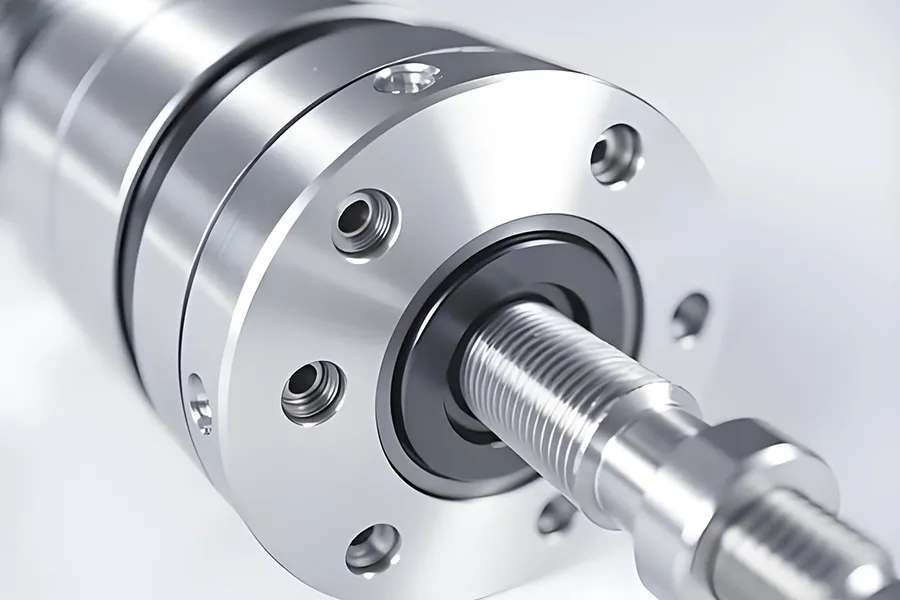
Ball screws, also known as ball screw assemblies, will be discussed in detail today, starting with their characteristics, composition and classification, several installation methods, and main parameters.
1. Characteristics of Ball Screws
1.1 Low Friction Loss and High Transmission Efficiency
Because there are many balls performing rolling motion between the screw shaft and the screw nut of the ball screw assembly, high motion efficiency is achieved. Compared with traditional sliding screw assemblies, the driving torque is less than 1/3, meaning that the power required to achieve the same motion result is only 1/3 of that required for a sliding screw assembly. This is very helpful in saving energy.
1.2 High Precision
Ball screw assemblies are generally manufactured using world-class mechanical equipment. Especially in the factory environment for grinding, assembly, and inspection processes, temperature and humidity are strictly controlled. A perfect quality management system ensures high precision.
1.3 High-Speed Feed and Micro-Feed Possible
Because ball screw assemblies utilize ball motion, the starting torque is extremely small, and there is no crawling phenomenon like in sliding motion, ensuring precise micro-feed.
1.4 High Axial Rigidity
Ball screw assemblies can be preloaded. The preload can make the axial clearance negative, resulting in high rigidity (by applying pressure to the balls inside the ball screw, the rigidity of the nut part is enhanced due to the repulsive force of the balls when actually used in mechanical devices).
1.5 Cannot Self-Lock, and Has Reversible Transmission
2. Composition and Classification of Ball Screws
A ball screw consists of a screw, nut, steel balls, preload plate, return mechanism, and dust cover. Its function is to convert rotational motion into linear motion. This is a further extension and development of the Acme screw, and the important significance of this development is that it changes the bearing from sliding motion to rolling motion. Due to its very low frictional resistance, ball screws are widely used in various industrial equipment and precision instruments.
There are many types of ball screws; here we will list some of the more common ones.
2.1 Self-Lubricating Ball Screw
Features a self-lubricating ball screw with a removable oil removal device, eliminating the need for lubrication piping systems and equipment, thus reducing oil change and waste oil disposal costs.
2.2 Silent Ball Screw
Its principle involves using specially grooved ball spacers between the balls to suppress the noise generated by collisions between the balls, making the ball screw movement quieter and smoother.
2.3 High-Speed Ball Screw
Features high acceleration, high rigidity, high feed rate, low vibration, and low noise. Used in applications such as rapid feed in machine tools, high-speed cutting centers for molds, and high-speed vertical cutting centers.
2.4 Heavy-Duty Ball Screw
Capable of withstanding large axial loads, suitable for applications such as all-electric design machines, air compressors, semiconductor manufacturing equipment, and forging and pressing equipment.
There is also a distinction between rolled and ground ball screws. Rolled ball screws have relatively lower accuracy and are suitable for applications where high precision is not required; while ground ball screws, as the name suggests, have higher accuracy and are suitable for applications requiring high precision.
Based on the ball circulation method in the nut, they can be divided into external circulation, internal circulation, and end cap types. The end cap type is an older structure with significant drawbacks and is now largely obsolete, so we will only briefly mention it here.
We won’t discuss the specific structure of internal and external circulation nuts in detail, as we don’t need to manufacture ball screws; we only need to know the differences and advantages and disadvantages of each.
3. Main Parameters of Ball Screws
When selecting a ball screw, it’s necessary to first understand its common parameters before determining the appropriate model.
3.1 Nominal Diameter
This refers to the outer diameter of the screw. Common specifications include 12, 14, 16, 20, 25, 32, 40, 50, 63, 80, 100, and 120 mm. However, please note that manufacturers generally only stock sizes from 16 to 50 mm. This means that other diameters are mostly made to order (production time is approximately 30-60 days, Japanese products are approximately 2-2.5 months, and European and American products are approximately 3-4 months).
The nominal diameter is basically proportional to the load; a larger diameter means a larger load. Specific values can be found in the manufacturer’s product catalog. Here, we will only explain two concepts: dynamic rated load and static rated load. The former refers to the rated axial load in motion, and the latter refers to the rated axial load in a stationary state. The former should be used for design purposes. It is important to note that the rated load is not the maximum load. The smaller the ratio of the actual load to the rated load, the higher the theoretical lifespan of the ball screw. Recommendation: Choose a diameter between 16 and 63 mm.
3.2 Lead
The lead refers to the distance the nut moves linearly for one rotation of the screw. Common leads are (in mm): 2, 4, 5, 6, 8, 10, 16, 20, 25, 32, and 40. Parameters related to the lead are the nut’s movement speed and the linear thrust provided by the ball screw.
The larger the lead, the faster the linear movement speed at the same rotational speed. The specific calculation is: v = ri, where v is the nut’s movement speed (in mm/s); r is the screw’s rotational speed (in r/s); and i is the lead (in mm).
The relationship between the lead and the screw thrust is: F = (2πT)/i. Where F is the screw thrust (in N); T is the torque provided by the motor (in N·m); η is the transmission efficiency (the transmission efficiency of ball screws is generally 85%~95%); and i is the lead (in meters).
3.3 Length
Length has two concepts: overall length and thread length. Some manufacturers only consider the overall length, but others require the thread length to be specified. Thread length also has two components: the total thread length and the effective stroke. The former refers to the total length of the threaded portion, while the latter refers to the theoretical maximum linear travel of the nut. Thread length = effective stroke + nut length + design margin (if needed, generally calculated as 1/8 of the maximum length of the protective cover). When installing a protective cover, the compressed length of the cover must also be considered.
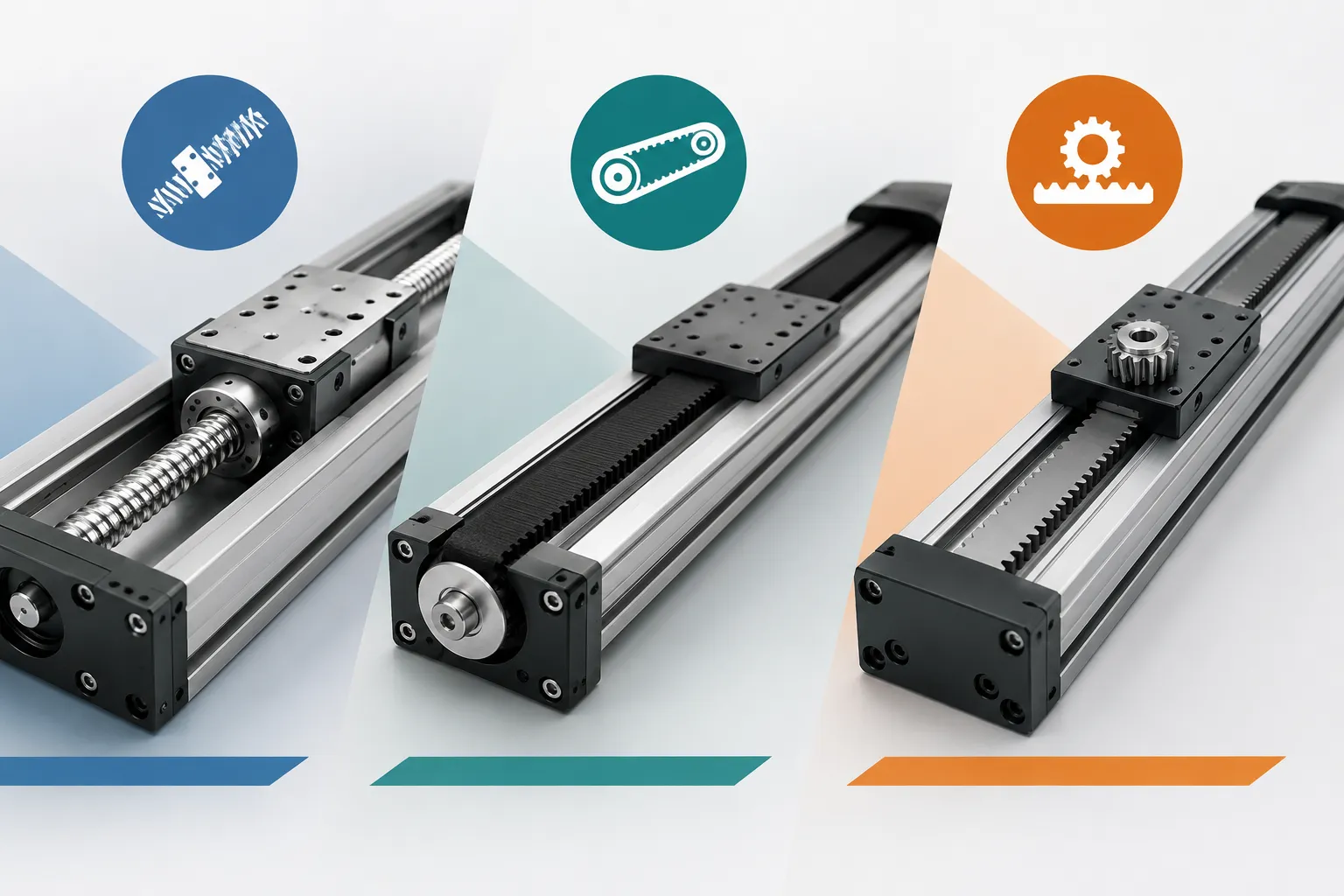
When designing and drawing, the overall length of the lead screw can be roughly calculated by adding the following parameters: Overall length = effective stroke + nut length + design margin + length of both ends of the support (bearing width + locking nut width + margin) + power input connection length (if using a coupling, it’s roughly half the coupling length + margin). It’s especially important to note that if your length is excessively long (greater than 3 meters) or the length-to-diameter ratio is very large (greater than 70), it’s best to consult the manufacturer’s sales personnel beforehand to see if production is possible. Generally, domestic manufacturers’ standard products have a maximum length of 3 meters, special products 16 meters; foreign manufacturers’ standard products are 6 meters, special products 22 meters. Of course, this doesn’t mean that domestic manufacturers can’t produce longer ones, but the price of custom-made products is quite exorbitant. Recommendation: Try to choose a length less than 6 meters; for longer lengths, using a gear and rack system is more cost-effective.
3.4 Nut Form
Manufacturers’ product catalogs usually show many different nut forms. The first few letters of the model number generally indicate the nut form. Based on the flange type, there are approximately circular flange, single-cut flange, double-cut flange, and flangeless types. Based on nut length, there are single nuts and double nuts (note that single and double nuts do not differ in load capacity or rigidity; do not listen to the manufacturer’s sales personnel on this point. The main difference between single and double nuts is that the latter allows for preload adjustment while the former does not. Also, the price and length of the latter are approximately twice that of the former). When installation dimensions and performance allow, designers should try to choose standard forms to avoid spare parts availability issues during maintenance. Recommendation: For frequent movement and high-precision applications, choose double nuts; for other applications, choose single-cut single nuts. Recommendation: For the nut type, it is recommended to choose an internal circulation double-cut flange single nut.
3.5 Accuracy
According to domestic classification, ball screws have accuracy grades of P1, P2, P3, P4, P5, P7, and P10. Japan, South Korea, and Taiwan use JS grades, namely C0, C1, C2, C3, C5, C7, and C10; European countries use standards IT0, IT1, IT2, IT3, IT4, IT5, IT7, and IT10.
Generally, our company purchases ball screws from Taiwan, which offer a higher cost-performance ratio, followed by those from Japan.
Generally speaking, ordinary machinery uses C7 and C10 grades, while CNC equipment generally uses C5 and C3 grades (C5 is more common; most domestic CNC machine tools are C5 grade). Aerospace manufacturing equipment, precision projection and coordinate measuring equipment generally use C3 and C2 accuracy.
In addition, C7 and C10 grades are generally manufactured using rolling methods, while C5 and higher grades are manufactured using grinding methods.
In summary, the commonly used ball screw accuracy grade for non-standard designs is C7 (manufactured by rolling method or what some call turning), and for those requiring higher accuracy, C5 (manufactured by grinding method) is sufficient. Of course, it’s still necessary to analyze specific situations.
3.6 Preload Level
Also called pre-tensioning, regarding preload, we don’t need to understand the specific pre-tensioning force and method; we only need to select the preload level according to the manufacturer’s sample. The higher the preload level, the tighter the fit between the nut and the screw; conversely, the lower the level, the looser the fit.
The principle to follow is: for large diameters, double nuts, high precision, and large driving torque, when the ball screw application exhibits the above situations, a higher preload level can be selected; otherwise, a lower level should be chosen.
4. Selection
After understanding the main parameters of the ball screw mentioned above, we can select the appropriate ball screw according to our requirements.
- Step 1: Based on the application scenarios of various ball screws mentioned in the “Classification of Ball Screws” section above, determine the type of ball screw suitable for your working conditions; at the same time, you can also determine the accuracy level (generally C7) and preload level of the ball screw;
- Step 2: Determine the shaft diameter of the ball screw based on the load size;
- Step 3: Determine the lead based on the required moving speed of the load: After determining the lead, determine the torque that the drive motor needs to provide based on the relationship between thrust and lead.
Specifically as follows: The object moves vertically up and down, with a weight of 60 kg, and the required moving speed is 1 m/s.
- If you choose a servo motor as the drive, the rated speed is 3000 r/min = 50 r/s. According to the formula: v = r, the lead is determined to be 20;
- Then calculate the load size: Assuming the acceleration and deceleration time of the servo motor is set to 0.3s, the acceleration is 3.3 m/s², and the load F = 600 + 60 * 3.3 = 798 N (friction is ignored here):
- According to the formula: F = (2π7n)/i, where n is 90%, the calculation yields ≈ 2.82 N·m. A 1 kW servo motor has a rated torque of 3.18 N·m, which meets the requirements.
In summary, the model of the ball screw is basically determined. Finally, determine the length of the ball screw based on the required stroke and the ball screw installation method mentioned above.
Summary
Ball screw actuators are core automation components that efficiently and accurately convert rotary motion into linear motion.
With advantages such as high efficiency, high precision, high rigidity, and long service life, they have become an indispensable and important component in modern industrial automation and precision machinery.