Automatic Welding Robot: Core Value and Practical Application in Manufacturing
In modern manufacturing, automated welding robots are highly automated welding devices. Replacing manual welding with them has become a trend in the welding industry, and is key to improving welding quality, cutting costs and optimizing work environments.
As an important symbol of the progress of modern manufacturing processes, robotic welding has been recognized by many domestic factories, and more and more enterprises prioritize automatic welding robots for process transformation.
1. Core Structural Composition of Automatic Welding Robot
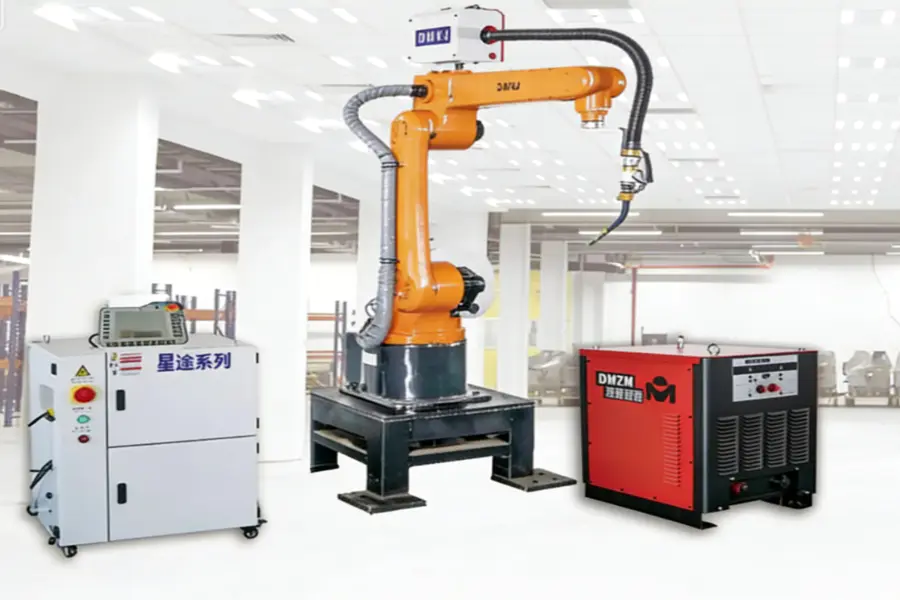
Using an automatic welding robot for welding requires not only the robot itself but also supporting peripheral equipment. A conventional arc welding robot system consists of five core components, detailed as follows:
| Component Name | Composition | Core Function |
|---|---|---|
| Robot Body | Servo motor-driven 6-axis articulated manipulator, including drivers, transmission mechanisms, robotic arms, joints, and internal sensors | Accurately ensure the required position, posture, and movement trajectory of the welding torch at the end of the manipulator |
| Robot Control Cabinet | Computer hardware, software, and specialized circuits | Process all operational information and control all actions of the robot (serves as the “nerve center”) |
| Welding Power Supply System | Welding power supplies, specialized welding torches, etc. | Provide necessary energy and tools for the welding process |
| Welding Sensors & Safety Protection Facilities | Welding sensors and safety protection devices | Monitor welding conditions in real time; safeguard equipment and operators |
| Welding Fixtures | Specialized positioning tools | Fix and position workpieces to ensure welding accuracy and consistency |
2. Configuration Schemes for Different Production Requirements
The automatic welding robot can be flexibly configured based on product characteristics to meet diverse production needs:
- For products with small batch sizes, multiple varieties, and large volume/weight: Adopt a simple automatic welding robot workstation or a combined workstation (welding positioner + robot), tailored to the spatial distribution of workpiece weld seams, suitable for “multi-variety, small-batch” flexible production.
- For products with small workpiece volume, easy transportation, large batch sizes, and multiple specifications: Subdivide the welding process, adopt a production line combining automatic welding robots and special welding machines, and integrate modular welding fixtures and quick mold change technology to achieve low-cost automation with less investment and high efficiency.
3. Key Advantages of Automatic Welding Robot
- Stable Quality: Minimizes human errors caused by fatigue or skill differences, maintaining consistent welding precision and meeting strict quality standards.
- Cost-Effective: Operates continuously without breaks, shortens production cycles, reduces material waste, and lowers long-term labor and operational costs.
- Safe & Reliable: Reduces workers’ exposure to high temperatures, toxic fumes, and other welding hazards, and is equipped with safety protection features (e.g., collision detection) to improve workplace safety.
4. Typical Application Scenarios
- Automotive Industry: Used in body-in-white assembly and component welding, ensuring the structural integrity and safety of vehicles.
- Heavy Machinery Manufacturing: Handles welding of large, thick components (e.g., excavators, cranes) to ensure weld strength and reliability.
- Aerospace Field: Welds high-precision critical components (e.g., aircraft wings, engine parts) with high-strength alloys, meeting stringent industry standards.
5. Future Development Trends
- Integration of AI and machine learning: Enables real-time optimization of welding parameters to adapt to material or joint changes.
- Collaborative robots (cobots): Work alongside human operators safely, enhancing production flexibility.
- IoT connection: Realizes remote monitoring, fault prediction, and workflow optimization through data transmission.
Conclusion
As a core equipment in modern welding manufacturing, the automatic welding robot stands out with its rational structural design and flexible configuration schemes. It not only addresses the pain points of traditional manual welding but also adapts to diverse production needs, becoming an indispensable strategic asset for enterprises pursuing efficiency, quality, and safety.
With continuous technological innovation, the automatic welding robot will further consolidate its role in manufacturing, driving the industry towards more efficient and sustainable development.