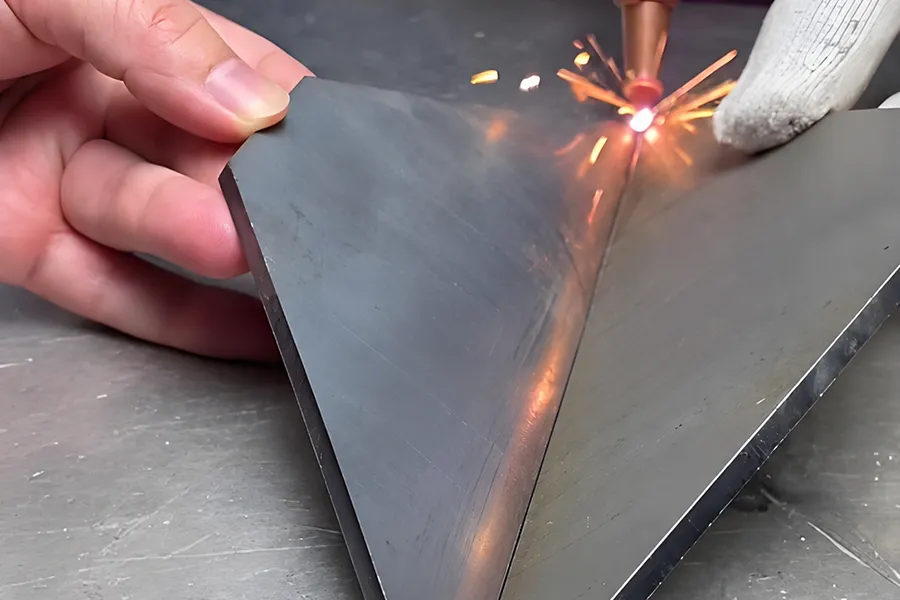

Welding robots are industrial robots designed for welding operations (including cutting and spraying). According to the International Organization for Standardization (ISO) definition of standard welding robots, an industrial robot is a multi-purpose, reprogrammable, automatically controlled manipulator with three or more programmable axes, used in industrial automation. To adapt to different applications, the mechanical interface of the robot’s final axis is typically a connecting flange that can mount various tools or end effectors. Industrial Welding robots are equipped with welding torches or welding (cutting) guns on the flange of the final axis, enabling them to perform welding, cutting, or thermal spraying operations.
1. Basic Principle
The fundamental operating principle of welding robots is teach-and-repeat. This involves the user guiding the robot to perform each step of the actual task. During this guidance, the robot automatically memorizes the position, orientation, motion parameters, welding parameters, and other details of each taught movement, generating a continuous program that executes the entire sequence. After teaching is complete, a single start command instructs the robot to precisely replicate the taught sequence step by step, executing the full operation. This process is termed actual teaching and reproduction.
2. Classification
Arc Welding Robots. Applicable to all arc welding, cutting techniques, and similar industrial methods. The most common applications include: – Gas Metal Arc Welding (GMAW) for structural steel and stainless steel (CO₂ welding, MAG welding) – Gas Metal Arc Welding (GMAW) for aluminum and special alloys – Gas Tungsten Arc Welding (GTAW) for stainless steel and aluminum – Submerged Arc Welding (SAW)
A complete arc welding robotic system should include a robotic manipulator, control system, welding equipment, and workpiece clamping device. The clamping device features two sets of rotating work tables that can alternately enter the robot’s working range.
Arc welding robots typically possess five or more degrees of freedom. A six-degree-of-freedom arc welding robot ensures arbitrary spatial trajectories and orientations for the welding torch. Point-to-point movement speeds exceed 60 m/min, with trajectory repeatability accuracy reaching ±0.2 mm. This arc welding robot should feature linear and circular interpolation swing functions, offering six swing patterns to meet welding process requirements. The robot’s payload capacity is 5 kg.
The most prevalent application of spot welding robots is in automated automotive body assembly workshops. These robots consist of the robot body, computer control system, teach pendant, and spot welding system. To accommodate flexible operational demands, spot welding robots typically adopt the basic design of articulated industrial robots, generally featuring six degrees of freedom: waist rotation, upper arm rotation, lower arm rotation, wrist rotation, wrist swing, and wrist twist. Driving methods include hydraulic and electric systems. Electric drives offer advantages such as simplified maintenance, low energy consumption, high speed, superior precision, and enhanced safety, making them the more widely adopted option. Spot welding robots execute spot welding operations according to the programmed sequence, sequence, and parameters specified in the teaching program. The process is fully automated and includes an interface for communicating with external equipment. Through this interface, the robot can receive control commands from higher-level master control and management computers to perform tasks.
3. Advantages of Industrial Welding Robots
(1) Stabilizes and enhances welding quality, quantifying results numerically;
(2) Increases labor productivity;
(3) Reduces worker labor intensity and enables operation in hazardous environments;
(4) Lowers requirements for operator technical skills;
(5) Shortens preparation cycles for product redesigns and reduces corresponding equipment investment.
Given their significant advantages over manual welding, welding robots have found extensive application across various industries.
4. Development Trends
In recent years, research and application of welding robot technology have yielded remarkable achievements in weld seam tracking, information sensing, offline programming and path planning, intelligent control, power supply technology, simulation technology, welding process methods, and remote-controlled welding technology. With the continuous advancement of computer technology, network technology, intelligent control technology, artificial intelligence theory, and industrial production systems, numerous critical issues remain to be thoroughly investigated in the field of welding robotics. Key future research directions will focus on visual control technology, fuzzy control technology, intelligent control technology, embedded control technology, virtual reality technology, and network control technology for industrial welding robots.