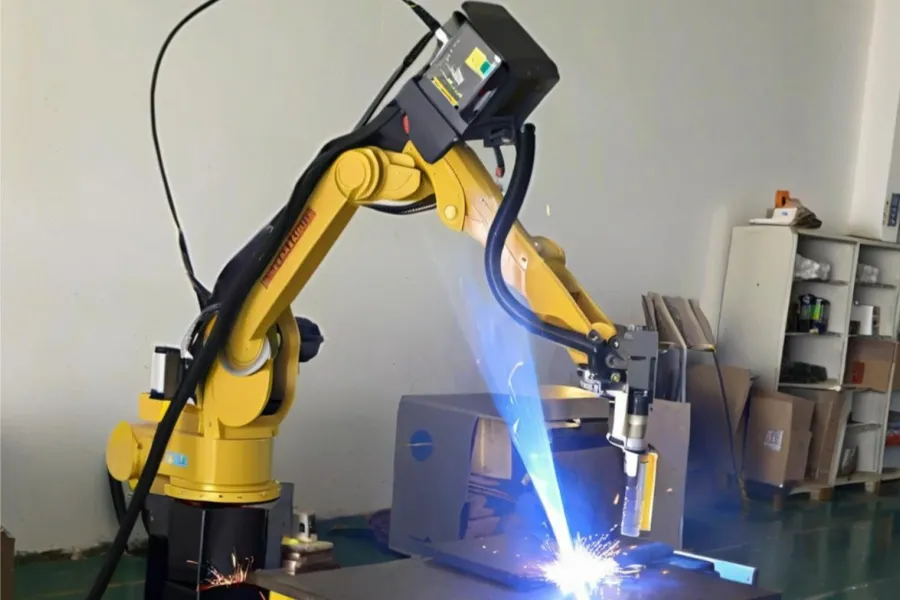
What is the working process of robot laser welding? Relevant data shows that by 2023, robot laser welding accounted for about 3.5% of the total sales of industrial robots in China. This main force in welding—robot laser welding—is not a single device, but a complex system that operates collaboratively through multiple modules including laser generators, mechanical actuators, control systems, and detection systems.
Working Process of Robot Laser Welding
1. Laser Heating for Robot Laser Welding
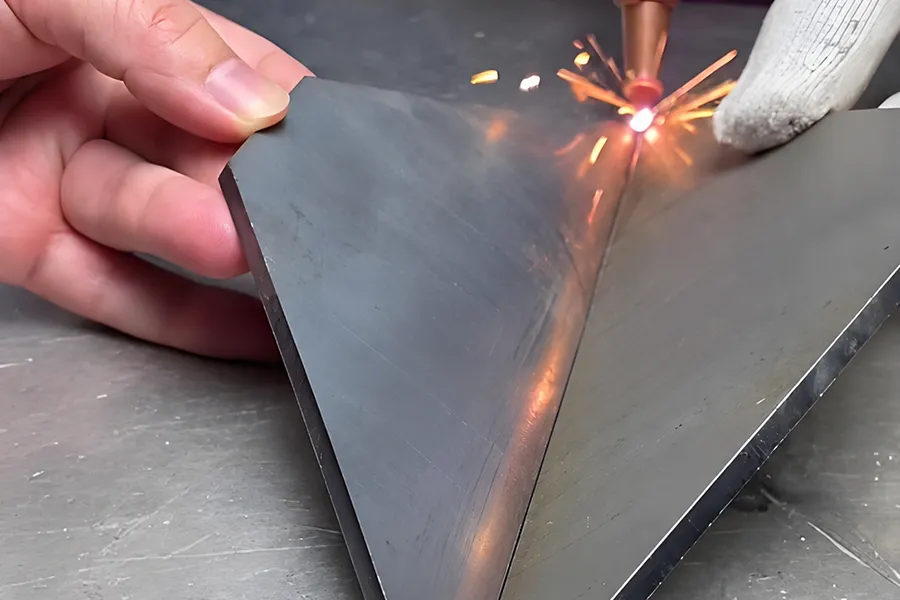
Robot laser welding uses a laser beam as the welding heat source. It generally adopts a semiconductor laser to provide a high-energy laser beam for robot laser welding operations.
2. Robot Laser Welding Parameter Adjustment
The control system is used to set process parameters (such as current output power) for robot laser welding.
3. Position Confirmation and Welding in Robot Laser Welding
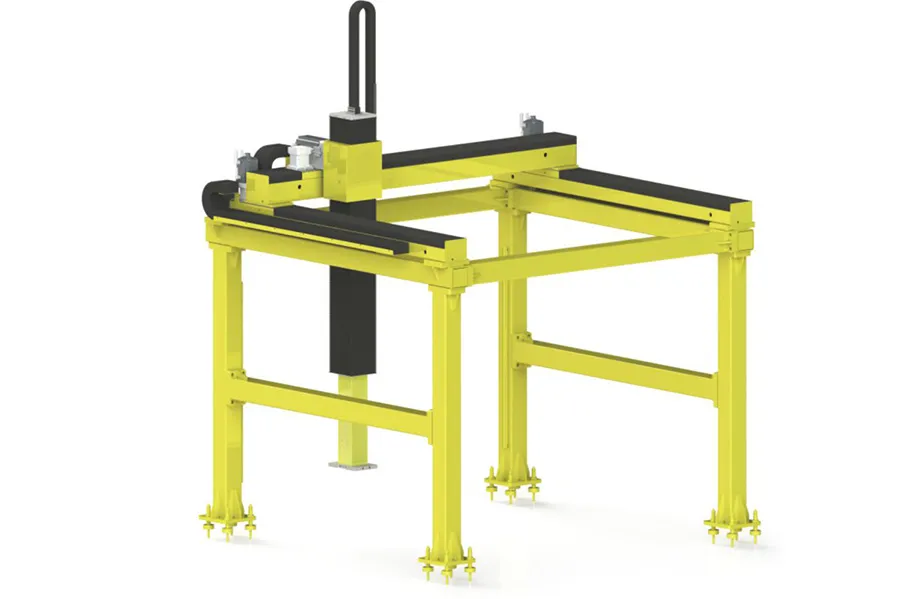
Subsequently, the mechanical arm of the robot laser welding system cooperates with a reducer to control the movement angle and speed, and performs welding according to the preset welding path. Also, depending on the shape and size of the welded workpiece, various positioners can carry out robot laser welding work simultaneously.
4. Real-Time Detection for Robot Laser Welding Quality
In addition, real-time detection and closed-loop control are important links to ensure robot laser welding quality. Robot laser welding systems are usually equipped with a visual inspection system and sensors:
- A high-speed camera captures images of the molten pool, and image algorithms analyze the size and shape of the molten pool to determine whether there are defects in robot laser welding (such as undercut or incomplete fusion);
- Infrared sensors monitor the temperature of the molten pool in real time to avoid workpiece deformation in robot laser welding;
- Force sensors perceive the contact force between the mechanical arm and the workpiece to prevent collision damage in robot laser welding.
Once an abnormality is detected (such as excessive molten pool temperature or blocked wire feeding in robot laser welding), the detection system immediately feeds the signal back to the control system, which quickly adjusts parameters—such as reducing laser power, pausing wire feeding, or adjusting the position of the mechanical arm—until it returns to normal, forming a “detection-feedback-adjustment” closed loop to ensure that each weld of robot laser welding meets quality standards.
Robot laser welding relies on the collaboration of multiple modules to complete its working process, which supports stable and high-quality operations in industrial robot laser welding scenarios.