Depending on the wire-feeding system, handheld laser welding machine can typically be configured with either single-wire or dual-wire feeding units. The primary difference lies not in the laser source itself, but in factors such as the number of wires, filler capacity, wire-feeding efficiency, and the types of workpieces for which they are suitable. So, how should one choose between single-wire and dual-wire handheld laser welding machines? This article compares the two from various perspectives.
1. Concepts of Single-Wire and Dual-Wire Feeding in Handheld Laser Welding Machine
Single-wire feeding in laser welding involves the use of a single wire-feed mechanism to advance and control the welding wire, whereas dual-wire feeding utilizes two independent mechanisms for this purpose.
2. Differences Between Single-Wire and Dual-Wire Feeding
2.1 Differences in Control Methods
The primary distinction lies in the control method. With single-wire feeding, both wire feed speed and welding current are regulated by a single electronic control unit. In contrast, dual-wire feeding requires two separate units to control these parameters independently, resulting in a more complex control scheme.
2.2 Differences in Applications
Single-wire feeding is suitable for relatively straightforward welding tasks, such as butt welding or multi-layer welding. Dual-wire feeding is better suited for more demanding applications—such as high-quality, high-speed welding of thick workpieces—or for fillet welding scenarios where the two weld beads can be controlled independently.
2.3 Filler Material Capacity
Single-wire systems feed one wire at a time, meeting most standard handheld laser welding machine needs; they are particularly well-suited for workpieces with neat joints and high assembly precision.
Dual-wire systems deliver more filler metal to the weld pool, offering advantages when handling wider welds, larger groove angles, or significant assembly gaps.
However, dual-wire feeding only improves gap tolerance within a certain range. If the gap is excessively large or uneven, it is still necessary to improve cutting precision, fixture positioning, and assembly quality, rather than relying solely on adding more wire to compensate.
2.4 Welding Efficiency
For standard thin sheets and narrow-gap welds, single-wire systems can typically achieve high welding speeds. They are easy to set up and allow for convenient wire changes, making them ideal for continuous production.
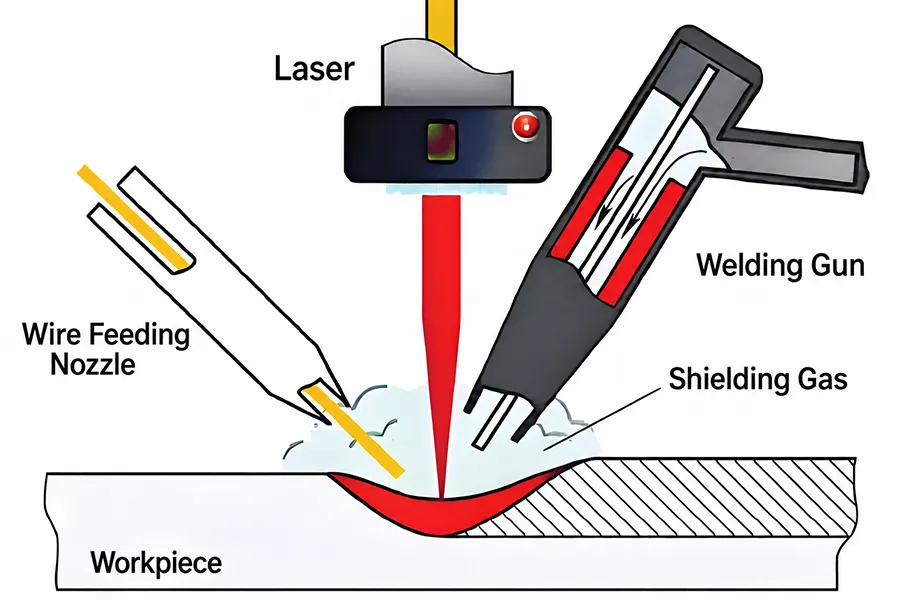
The advantages of dual-wire feeding are most apparent in welding tasks that require a significant amount of filler material. Compared to single-wire feeding—which often requires slower speeds or multiple passes to fill the joint—dual-wire feeding offers the potential to create wider, fuller weld seams in a single pass, thereby boosting overall productivity.
However, the actual efficiency of dual-wire feeding depends on several factors:
- Adequacy of laser power
- Stability of the wire feed speeds for both wires
- Matching of the welding torch travel speed
- Consistency of the workpiece gap
- Operator’s ability to maintain stable control of the torch
5. Differences in equipment and consumable costs
Single-wire feeding systems feature a simple design, resulting in lower procurement costs, easier maintenance, and reduced wire consumption; they are suitable for most standard welding tasks.
Dual-wire feeding systems involve more complex structures and control systems, generally leading to higher initial equipment costs. Consumable costs may also rise due to the simultaneous use of two wires.
However, equipment price alone should not be the deciding factor. If dual-wire feeding eliminates the need for multi-pass welding, rework, or pre-weld gap preparation, the overall production cost may still prove more advantageous.
6. Differences in Advantages and Disadvantages
Single-wire feeding offers the advantages of simple control, low cost, and ease of operation; however, weld quality can be more easily compromised, and welding speeds are relatively slower. Dual-wire feeding provides superior stability, faster welding speeds, and more consistent weld quality, but it involves more complex equipment and higher costs.
3. Examples of Applications
In automotive manufacturing, single-wire feeding is used for car body butt welding or repair welding, while dual-wire feeding is applied to chassis or engine components. In aircraft manufacturing, single-wire feeding simplifies butt welding, whereas dual-wire feeding enables high-speed welding of small titanium alloy components.
4. How should you choose between single-wire and dual-wire feeding?
When selecting a wire feeding system, consider the following key factors:
4.1 Based on workpiece gap
If the workpiece joint is tight and the gap is consistent, single-wire feeding is the preferred choice. If the joint is relatively wide or requires greater gap tolerance, dual-wire feeding may be considered.
4.2 Based on material thickness
Single-wire feeding is generally suitable for thin sheets and workpieces of standard thickness. Dual-wire feeding offers advantages for thick plates, beveled joints, or large fillet welds that require more filler material.
Material thickness is merely a reference factor and should not be the sole basis for selection; joint configuration, laser power, and welding requirements are equally important.
4.4 Based on weld seam requirements
Single-wire feeding is usually easier to control when a narrow, refined weld seam is required. Dual-wire feeding may be considered if a wide, full weld seam is needed.
4.5 Based on product consistency
Single-wire feeding is typically more cost-effective for mass-produced items characterized by high standardization and consistent assembly precision.
If there is a wide variety of workpieces or significant variation in joint width, dual-wire feeding offers more flexible filling capabilities—though it cannot replace proper assembly procedures.
Conclusion
Since both handheld laser welding machine single-wire and dual-wire feeding systems have their own distinct advantages, disadvantages, and application scenarios, the choice must be based on specific production requirements. Ultimately, selecting between the two involves weighing multiple factors, including weld quality, speed, system complexity, and cost.