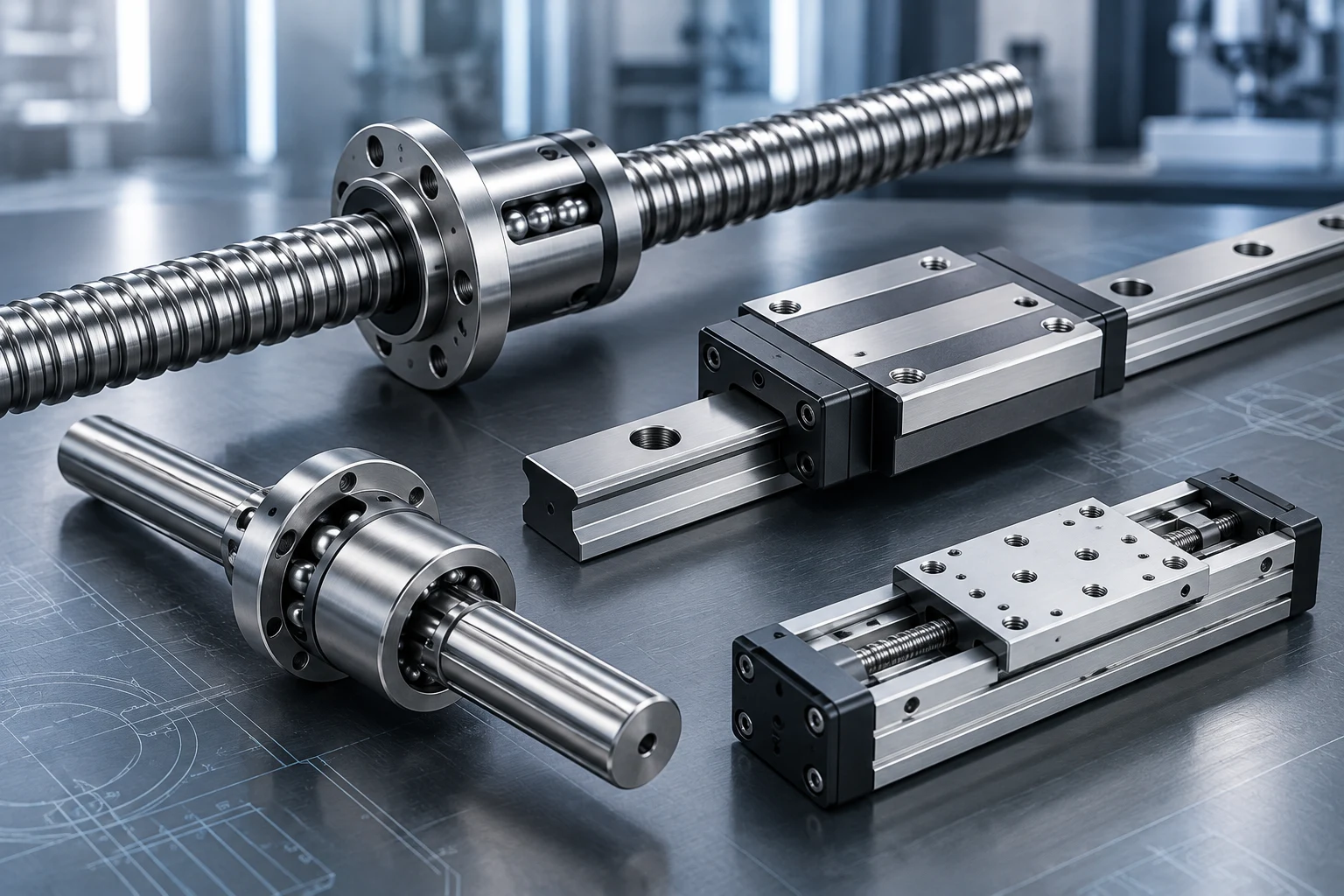
Linear motion components are essential mechanical elements used in machine tools, industrial automation systems, precision equipment, and robotics. They convert motion, guide moving parts, transmit loads, and help machines achieve accurate and repeatable positioning.
Common linear motion components include ball screws, planetary roller screws, trapezoidal lead screws, ball splines, linear guideways, and linear modules. Although these products are often used together in the same machine, they serve different functions and have distinct structural characteristics, load capacities, and performance requirements.
Understanding these differences is essential when selecting components for a new machine, optimizing an existing motion system, or evaluating suppliers.
This article explains the main types of linear motion components, their working principles, manufacturing processes, industrial applications, and the technical challenges that influence product quality and market competitiveness.
1. Main Types of Linear Motion Components
1.1 Ball Screw Assemblies
A ball screw assembly converts rotary motion into linear motion, or linear motion into rotary motion, through rolling contact between balls and the screw shaft and nut.
A typical ball screw assembly consists of three primary elements: the screw shaft, ball nut, and recirculating steel balls. The balls roll along the helical raceways between the shaft and nut, reducing friction compared with conventional sliding screw mechanisms.
Key advantages:
- High transmission efficiency
- High positioning accuracy and repeatability
- Low friction and relatively smooth motion
- Good axial load capacity
- Suitability for high-speed positioning applications
Ball screws are widely used in CNC machine tools, industrial automation, precision positioning systems, engraving machines, and material handling equipment.
Common applications include feeding, indexing, labeling, dispensing, and automated workpiece positioning.
Ball screw performance depends on factors such as lead accuracy, preload, axial stiffness, critical speed, lubrication, and installation conditions. The appropriate specification should be selected according to the application’s load, speed, stroke, and positioning requirements.
1.2 Planetary Roller Screws
Planetary roller screws convert rotary motion into linear motion using threaded rollers positioned between the screw shaft and nut. The rollers distribute loads through multiple contact regions, enabling high load capacity and high stiffness within a compact mechanism.
Compared with ball screws, planetary roller screws can offer advantages in load density, stiffness, and durability under demanding operating conditions. However, actual performance depends on the screw design, size, preload, materials, lubrication, and operating environment.
Key characteristics:
- High load capacity relative to size
- High mechanical stiffness
- Suitability for demanding force and duty-cycle requirements
- Potential for long service life under appropriate operating conditions
Planetary roller screws are used in high-force actuators, aerospace mechanisms, industrial machinery, and certain robotic actuator designs.
Their manufacturing and assembly requirements are demanding, and their cost is generally higher than that of conventional ball screws. They are therefore typically selected when their performance advantages justify the additional investment.
1.3 Trapezoidal Lead Screws
Trapezoidal lead screws, also called sliding lead screws, use sliding contact between the screw thread and nut rather than recirculating balls or rollers.
Because the contact surfaces slide against each other, friction is generally higher than in rolling screw mechanisms. This reduces transmission efficiency but can provide a relatively simple and economical solution.
Advantages:
- Simple structure
- Relatively low manufacturing and purchasing costs
- Straightforward maintenance
- Potential self-locking capability under suitable design conditions
Limitations:
- Lower transmission efficiency
- Greater friction and wear
- More heat generation during operation
- Potentially lower positioning accuracy and repeatability over time
Self-locking is not guaranteed. It depends on factors such as lead angle, thread geometry, and the coefficient of friction.
Trapezoidal lead screws are suitable for simple adjustment mechanisms, low-speed positioning systems, manual equipment, and applications where cost and structural simplicity are more important than high efficiency.
1.4 Ball Splines
A ball spline is a linear motion component designed to transmit torque while allowing axial movement along a shaft.
Its structure includes a spline shaft with longitudinal raceways, a spline nut, and rolling balls. Unlike the helical raceways of a ball screw, the ball spline’s longitudinal raceways enable the nut to move axially while maintaining rotational engagement with the shaft.
In a typical ball spline arrangement, the shaft and nut do not rotate relative to each other freely as they would in a ball screw mechanism. Instead, the spline transfers torque while permitting controlled axial movement.
Key advantages:
- High torque transmission capability
- Low-friction axial movement
- High stiffness and accurate guidance
- Suitability for compact rotary-linear mechanisms
Ball splines are commonly used in robotic mechanisms, automated assembly equipment, pick-and-place systems, and machinery requiring combined rotary and linear motion.
They should not be confused with ball screws: a ball screw primarily converts rotary motion into linear motion, while a ball spline transmits torque and allows axial travel.
1.5 Linear Guideways
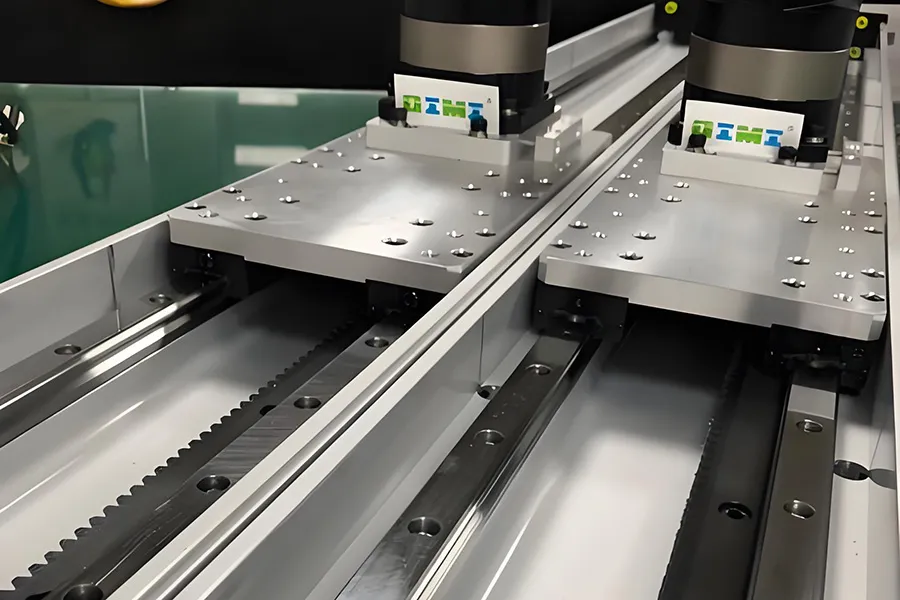
Linear guideways, also known as linear guides or linear motion guideways, support and guide moving machine components along a defined straight path.
A typical rolling linear guideway consists of a guide rail, a carriage or block, and rolling elements. The carriage moves along the rail while the rolling elements reduce friction and support external loads.
Linear guideways do not normally generate the driving force by themselves. They work with a drive mechanism, such as a ball screw, belt, linear motor, or pneumatic actuator.
Linear guideways are available in several configurations, including ball-type and roller-type designs.
Ball-type linear guides generally provide smooth motion, relatively low friction, and versatile performance across a wide range of applications.
Roller-type linear guides use rollers rather than balls. Their contact geometry can provide higher load capacity and stiffness for comparable product sizes, depending on the design.
Important selection parameters include:
- Dynamic and static load ratings
- Moment load capacity
- Accuracy class
- Preload level
- Rigidity and running smoothness
- Lubrication requirements
- Environmental protection and service life
Linear guideways are widely used in CNC machine tools, semiconductor manufacturing equipment, industrial automation, precision measuring systems, and automated production lines.
For demanding applications, material quality, raceway geometry, heat treatment, manufacturing accuracy, and long-term precision retention are important evaluation criteria.
1.6 Linear Modules and Motorized Slides
Linear modules integrate several motion components into a single mechanical unit. Depending on the design, a module may include a base, guide mechanism, transmission system, carriage, motor interface, and protective enclosure.
This integration simplifies machine design and reduces the work required to select, align, and assemble individual components.
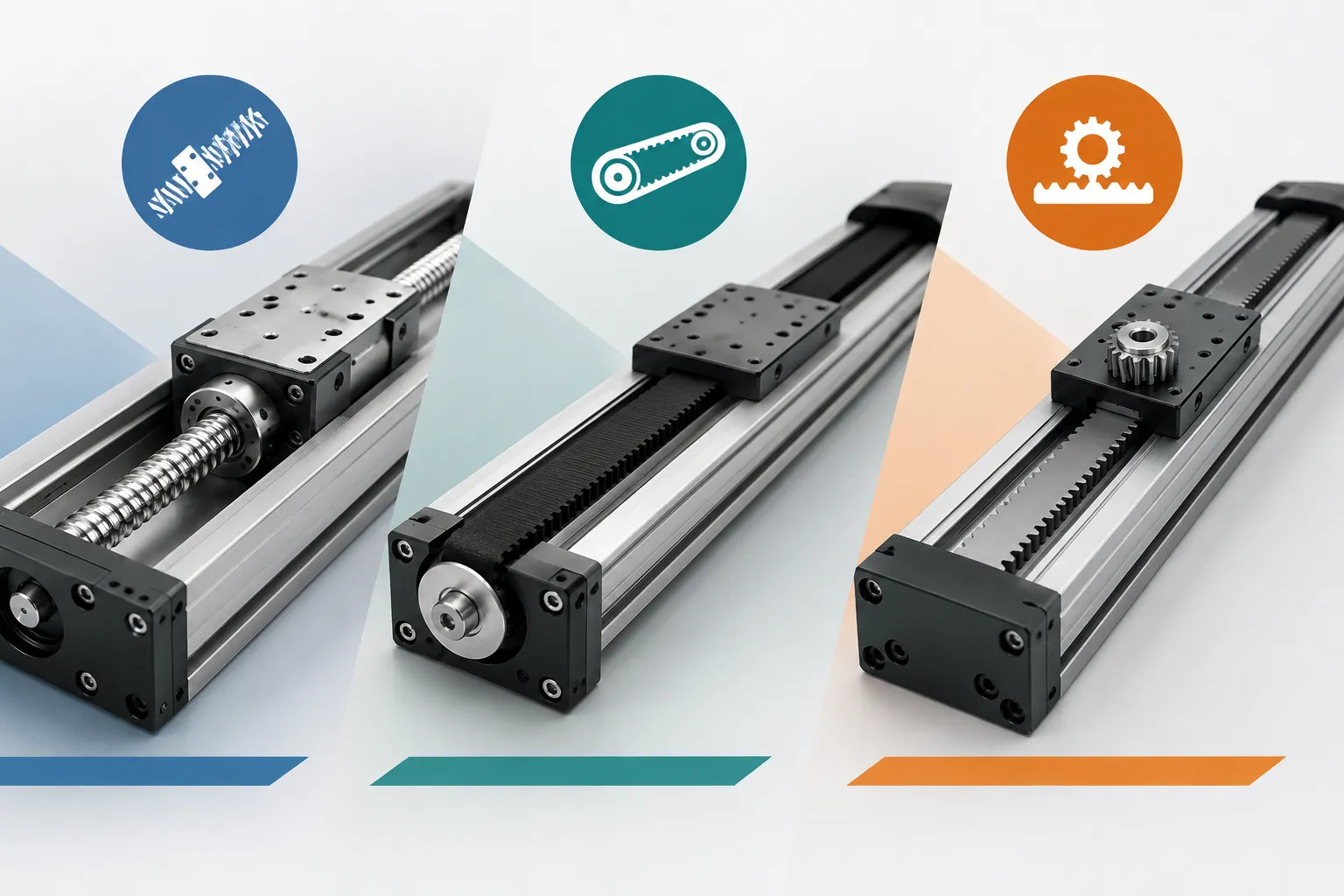
Two common drive configurations are belt-driven linear modules and ball-screw-driven linear modules.
Belt-driven linear modules
These modules use a motor-driven timing belt to move the carriage.
They are often suitable for long travel distances, high-speed transportation, and applications where rapid movement is a priority.
Typical applications include packaging machinery, automated inspection, electronics manufacturing, and general material handling.
Ball-screw-driven linear modules
These modules use a rotating ball screw to drive the carriage along a guided path.
They are often selected for applications requiring controlled positioning, higher axial stiffness, and good repeatability.
Typical applications include precision assembly, dispensing, machining, and automated positioning systems.
Linear modules can also be classified by their structural design, such as open, semi-enclosed, and fully enclosed configurations. Enclosed designs can help protect internal components from dust and debris, although the required protection level depends on the working environment.
The terms linear module, linear actuator, motorized slide, and single-axis robot are sometimes used interchangeably in the industry. However, their exact meanings vary by manufacturer. The actual internal structure and performance specifications should always be checked before selecting a product.
2. How Ball Screws and Linear Guideways Work Together
Ball screws and linear guideways are often used together in precision motion systems because they perform complementary functions.
The ball screw generates the axial driving force that moves the carriage, while the linear guideways constrain the carriage’s movement and support external loads and moments.
A typical ball-screw-driven linear axis includes:
- Servo motor: Supplies the driving torque.
- Ball screw: Converts motor rotation into linear displacement and transmits axial force.
- Linear guideways: Support the moving assembly and maintain its travel direction.
- Carriage or table: Carries the workpiece or machine component.
- Control system: Regulates position, speed, acceleration, and motion sequences.
The load distribution depends on the machine’s structural design, but the ball screw and guideways should be selected as parts of a coordinated system.
For example, an undersized guideway may fail to provide sufficient stiffness under an offset load, even if the ball screw itself has adequate axial capacity. Similarly, a ball screw with insufficient critical speed or stiffness may limit the performance of an otherwise well-designed linear axis.
Correct component selection therefore requires evaluating the entire motion system rather than considering each component in isolation.
3. The Linear Motion Components Supply Chain
The linear motion components industry involves raw material suppliers, precision component manufacturers, system integrators, machine builders, and end users.
3.1 Upstream: Materials and Basic Components
Upstream suppliers provide the materials and basic components used in manufacturing ball screws, linear guideways, and related products.
These may include alloy steel, bearing steel, rolling balls, rollers, nuts, bearings, and other mechanical elements.
Material properties directly influence fatigue resistance, wear resistance, hardness, dimensional stability, and load-bearing performance.
However, material selection alone does not determine final product quality. Heat treatment, machining accuracy, surface finish, assembly, and quality control are equally important.
For example, rolling balls may appear simple, but their manufacture requires carefully controlled processes such as forming, heat treatment, grinding, finishing, cleaning, and dimensional inspection. Variations in ball diameter, roundness, surface quality, and hardness can affect contact conditions and the performance of the complete assembly.
3.2 Midstream: Precision Manufacturing and Assembly
The midstream stage transforms raw materials and basic components into finished linear motion products.
Typical processes include:
- Turning and preliminary machining
- Raceway grinding or other precision machining operations
- Heat treatment
- Surface finishing
- Screw and nut assembly
- Ball or roller recirculation system assembly
- Preload adjustment
- Dimensional and performance inspection
The specific processes differ by product type and manufacturing method.
For high-precision ball screws, important factors include lead accuracy, raceway geometry, axial clearance, preload, straightness, and surface finish.
For linear guideways, critical factors include rail straightness, raceway accuracy, carriage geometry, preload, and consistency of rolling resistance.
For integrated linear modules, the alignment of the guideways and drive mechanism also affects positioning performance, rigidity, and operating life.
3.3 Downstream: Equipment Manufacturers and End Users
Downstream customers use linear motion components in a wide range of machines and production systems.
Major application areas include:
- CNC machine tools and industrial machinery
- Electronics manufacturing and automated assembly
- Semiconductor and precision inspection equipment
- Automotive manufacturing and electric vehicle production
- Battery manufacturing and material handling
- Packaging and printing machinery
- Medical and laboratory equipment
- Industrial robotics and selected robotic actuator systems
Different industries require different combinations of accuracy, load capacity, speed, rigidity, durability, and environmental protection.
Consequently, a supplier’s competitiveness depends not only on component specifications but also on its ability to meet application-specific requirements consistently.
4. Major Applications and Market Drivers
4.1 Machine Tools and Industrial Manufacturing
Machine tools remain an important application area for ball screws and linear guideways.
These components influence positioning accuracy, machining stability, feed motion, and the ability of a machine to maintain performance over time.
High-performance machine tools may require tightly controlled geometry, thermal stability, preload, stiffness, and long-term precision retention.
For manufacturers, replacing an established component supplier is not simply a matter of comparing purchase prices. The replacement product must also meet performance requirements and pass application testing.
4.2 Industrial Automation and Battery Manufacturing
Automated production lines rely on linear motion components for positioning, feeding, loading, unloading, inspection, and assembly.
Linear modules are especially useful when equipment manufacturers need standardized motion units that can be integrated into larger automation systems.
Battery manufacturing and electric vehicle production also use linear motion components in equipment for material transfer, electrode processing, inspection, assembly, and packaging.
The specific requirements vary by process. High-speed transport systems may prioritize travel speed and stroke length, while precision assembly stations may place greater emphasis on repeatability, stiffness, and positional stability.
4.3 Semiconductor and Precision Equipment
Semiconductor and precision equipment can impose demanding requirements on motion systems.
Depending on the application, these may include high positioning accuracy, smooth movement, low vibration, controlled particle generation, thermal stability, and strict environmental compatibility.
Not every application requires the same configuration. The appropriate guideway or screw must be selected according to the machine’s actual performance targets and operating environment.
4.4 Robotics and Emerging Actuator Technologies
Robotics is another application area for linear motion technology.
Conventional industrial robots commonly use precision transmission components in positioning stages, auxiliary axes, and selected actuator mechanisms. Newer robotic architectures may also use compact, high-force linear actuators.
Planetary roller screws have attracted attention for certain demanding actuator designs because of their potential load density and stiffness advantages.
However, future demand depends on the actuator architecture, production volume, target cost, reliability requirements, and the extent to which a particular design is adopted commercially.
Emerging applications should therefore be considered alongside established markets rather than treated as guaranteed sources of demand.
5. Why High-Precision Linear Motion Components Are Difficult to Manufacture
The performance gap between different linear motion products is not explained by a single factor. It results from the interaction of materials, precision machining, heat treatment, assembly, inspection, and production consistency.
5.1 Material Selection and Heat Treatment
The base material affects hardness, fatigue resistance, wear behavior, and dimensional stability.
Heat treatment must achieve the required mechanical properties while controlling distortion and residual stresses.
Inadequate process control can lead to inconsistent hardness, premature wear, reduced fatigue life, or dimensional changes during subsequent machining and operation.
High-quality production therefore requires suitable materials, validated process parameters, and repeatable heat-treatment control.
5.2 Precision Machining and Grinding
Ball screw raceways and linear guideway raceways require carefully controlled geometry and surface finish.
Machining errors can influence contact conditions, friction, positioning accuracy, stiffness, and service life.
Precision grinding equipment, suitable tooling, process monitoring, and skilled process engineering are important for maintaining product accuracy.
The challenge is not simply to achieve a target measurement on one component, but to maintain the required accuracy across the entire production process.
5.3 Design, Preload, and Assembly
Preload is used in many rolling motion products to reduce internal clearance and improve stiffness. However, excessive preload can increase friction, heat generation, and drive torque.
The correct preload depends on the application, load, speed, stiffness requirement, and thermal conditions.
Assembly accuracy is also critical. Incorrect alignment, unsuitable mounting surfaces, or improper installation can degrade the performance of components that individually meet their dimensional specifications.
For this reason, product engineering must consider the relationship between the component, mounting structure, drive system, and working environment.
5.4 Inspection and Production Consistency
A manufacturer may be capable of producing a high-precision prototype without having the process capability to manufacture thousands of equivalent products reliably.
Batch consistency requires controlled processes, calibrated measurement equipment, traceability, statistical process control where appropriate, and clear acceptance criteria.
Important evaluation metrics may include dimensional variation, lead accuracy, running torque, preload consistency, noise, vibration, and life-test results.
The exact metrics depend on the product and its intended application.
5.5 Equipment Investment and Manufacturing Experience
Precision manufacturing often requires specialized machinery, inspection equipment, production engineering, and process development.
These investments can create a barrier to entry, particularly for products requiring tight tolerances and consistent high-volume output.
However, equipment ownership alone does not guarantee superior products. Manufacturing capability also depends on process design, maintenance, metrology, engineering experience, and continuous improvement.
Similarly, purchasing components from external suppliers does not automatically make a system integrator less competitive. A well-designed linear module can create substantial value through structural optimization, system integration, calibration, and application engineering.
5.6 Customer Qualification and Reliability
In high-value industrial equipment, a component failure can cause downtime, scrap, maintenance costs, or production losses.
Machine builders therefore evaluate more than the purchase price. They may require endurance testing, qualification trials, technical documentation, traceability, and evidence of stable production quality.
Once a component has been validated in a demanding application, changing suppliers may require additional engineering work and testing.
This makes long-term reliability, technical support, and consistent delivery important competitive factors.
6. Market Structure and Domestic Manufacturing Development
The linear motion components market includes products with very different technical requirements and price points.
At one end are standard components used in general automation and applications with moderate accuracy and load requirements. At the other are precision products designed for demanding machine tools, semiconductor equipment, aerospace systems, and other high-performance applications.
The distinction is not simply between expensive and inexpensive products. It concerns the performance level required by the application and the manufacturer’s ability to deliver that performance consistently.
6.1 Standard and High-Performance Market Segments
Standard applications often prioritize cost-effectiveness, availability, ease of integration, and reliable operation.
High-performance applications may demand tighter geometric tolerances, greater stiffness, better precision retention, more consistent preload, higher reliability, and more extensive technical validation.
These requirements can create different competitive environments within the same product category.
A component suitable for general material handling should not automatically be considered suitable for a high-precision machine tool. Product specifications and application test results must support the intended use.
6.2 Domestic Manufacturing and Localization
Domestic manufacturers have opportunities to expand their presence in industrial automation and precision machinery by improving manufacturing processes, product consistency, application engineering, and customer support.
Localization is not a single milestone. A supplier may be competitive in standard linear guideways or ball screws while continuing to develop its capabilities in more demanding applications.
Progress should be evaluated at the product and application level, using measurable evidence such as:
- Achievable accuracy and repeatability
- Load capacity and stiffness
- Service life and precision retention
- Batch-to-batch consistency
- Product range and customization capability
- Delivery reliability and technical support
It is therefore more useful to compare specific products and documented performance than to make broad claims about the quality of products from a particular country or region.
6.3 Why Market Statistics Require Careful Interpretation
Industry reports sometimes group ball screws, linear guideways, linear modules, and other rolling functional components into a broader market category.
As a result, published market-size estimates may differ significantly depending on the products included, geographic coverage, reporting period, and research methodology.
When evaluating market opportunities, it is important to distinguish the overall rolling functional components market from individual product markets.
Historical market estimates and forecasts for earlier periods should also be clearly dated rather than presented as current market conditions.
A reliable market assessment should combine clearly defined market data with application demand, customer purchasing behavior, competitive positioning, and the technical requirements of each product segment.
7. How to Select the Right Linear Motion Components
Selecting a linear motion component requires matching the product’s technical characteristics to the actual operating conditions.
The following factors should be considered during the selection process.
1. Load and moment requirements
Determine the axial, radial, and lateral loads, as well as the moments acting on the mechanism. For linear guideways, evaluate the load distribution across the carriages and the effects of load offsets.
2. Accuracy and repeatability
Define the required positioning accuracy, repeatability, straightness, and precision retention. These are related but distinct performance characteristics.
3. Speed, acceleration, and travel distance
Check maximum speed, acceleration, duty cycle, stroke length, critical speed where applicable, and the dynamic performance of the complete system.
4. Stiffness and preload
Evaluate the rigidity required to control deformation under load. Select preload according to the application’s stiffness, friction, heat generation, and operating requirements.
5. Environment and lubrication
Consider dust, moisture, temperature, corrosion risks, contamination, and maintenance accessibility. Choose appropriate lubrication and protective measures.
6. Installation and integration
Check mounting surface accuracy, alignment, available space, mounting interfaces, and compatibility with the motor and control system.
7. Service life and total cost
Compare expected service life, maintenance requirements, replacement intervals, delivery reliability, and the cost of downtime—not just the initial purchase price.
A suitable component is one that meets the required performance targets reliably and economically throughout the intended operating life.
8. Frequently Asked Questions
What is the difference between a ball screw and a linear guideway?
A ball screw converts rotary motion into linear motion and transmits axial force. A linear guideway supports and guides a moving component along a straight path while carrying external loads. They are commonly used together in precision motion systems.
What is the difference between a ball screw and a trapezoidal lead screw?
A ball screw uses rolling balls to reduce friction and generally offers higher transmission efficiency. A trapezoidal lead screw relies on sliding contact, making it simpler and often less expensive, but generally less efficient and more susceptible to wear.
What is the difference between a ball spline and a ball screw?
A ball spline transmits torque while allowing axial movement along a shaft. A ball screw primarily converts rotary motion into linear motion through a helical ball-raceway mechanism.
What determines the service life of a linear guideway?
Service life depends on factors such as applied loads, moments, lubrication, contamination, installation accuracy, preload, operating conditions, and maintenance. Correct sizing and installation are essential for achieving the expected service life.
Are linear modules and linear guideways the same product?
No. A linear guideway is a guiding component consisting of a rail and carriage. A linear module is an integrated motion unit that may include guideways, a drive mechanism, a base, and motor interfaces.
How can manufacturers evaluate a linear motion component supplier?
Manufacturers should review product specifications, manufacturing capability, inspection methods, documented test results, batch consistency, traceability, delivery performance, and technical support. Samples should be evaluated under conditions representative of the intended application.
Conclusion
Linear motion components are fundamental to modern industrial machinery, but different products serve different mechanical functions. Ball screws transmit axial force through rotary-to-linear motion conversion, linear guideways support and guide moving assemblies, ball splines transmit torque while allowing axial movement, and linear modules integrate these functions into convenient motion units.
Reliable performance depends on more than individual component specifications. Material selection, precision machining, heat treatment, preload, assembly accuracy, lubrication, and production consistency all contribute to the quality of the finished system.
For equipment manufacturers and engineering teams, understanding these relationships makes it easier to select appropriate components, evaluate suppliers, and develop motion systems that meet real-world requirements for accuracy, load capacity, durability, and cost-effectiveness.