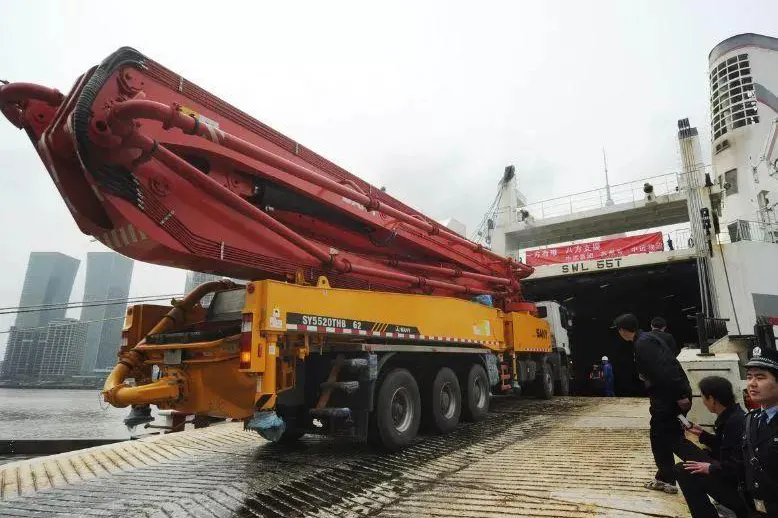
In 2011, following the Fukushima nuclear disaster in Japan, Japan, through its Ministry of Foreign Affairs, requested assistance from Chinese concrete pump truck manufacturers, hoping for an emergency concrete pump truck to be dispatched for high-altitude water delivery and cooling at the Fukushima nuclear power plant.
Ultimately, the Chinese company Sany Heavy Industry donated a pump truck worth $1 million with a 62-meter boom. At the time, a boom length of at least 56 meters was needed, but Japan could only produce pump trucks with boom lengths under 50 meters. Meanwhile, Chinese companies could produce the world’s longest 72-meter boom pump truck, which could be operated wirelessly from 2 kilometers away, ensuring operator safety. Subsequently, China developed 80-meter and 101-meter pump trucks, repeatedly breaking world records.
Accompanying the donated pump truck to Japan were two technical advisors and sufficient spare parts. This pump truck played a crucial role in the rescue efforts, and Chinese concrete pump trucks once again garnered global attention.
1. What is a concrete pump truck?
A concrete pump truck is a machine that uses pressure to continuously transport concrete along pipelines. It can transport concrete horizontally or vertically into confined spaces and plays a vital role in construction projects, water conservancy projects, and other engineering endeavors.
Concrete Pump Trucks are High-End Equipment in the Mechanical Engineering Industry
In our minds, concrete pump trucks are bulky and heavy machines, but they are actually highly sophisticated pieces of equipment. The boom is a key component, needing to extend to heights of tens of meters and withstand the immense pressure during pumping. The steel plates used to manufacture the boom must have a strength exceeding 600 MPa—equivalent to placing an elephant on a fingernail.
To accurately deliver concrete to the designated location, computer control is required to regulate its direction, speed, and prevent swaying during transport. Therefore, concrete pump trucks are high-end equipment in the mechanical engineering industry.
2. Main Structure of a Concrete Pump Truck
A concrete pump truck consists of a pumping system, hydraulic system, electrical control system, and boom system mounted on a heavy-duty truck, used to transport concrete to a specific height or distance.
Structure
- Boom System: Completes the concrete delivery, supports the entire vehicle, and ensures its stability during delivery. It consists of a placing boom and a turret.
- Pumping System: The pumping system is the actuator of the concrete pump truck, used to continuously deliver concrete along pipelines to the pouring site. It mainly consists of a pumping mechanism, a lubrication mechanism, and a hopper.
- Electrical Control System: Utilizes electricity to transmit operating commands to various mechanical components. It mainly consists of a remote control, sensors, and an operating box.
- Hydraulic System: Increases force by changing pressure to achieve energy conversion. It mainly consists of an oil pump, an oil tank, and a boom pump.
3. Development Background of Concrete Pump Trucks
Humans live on an earth composed of massive rocks. In ancient times, people used stones to build houses. In modern times, people use reinforced concrete to build homes, making houses taller and faster. This development owes much to concrete pump trucks, whose development has accompanied the world’s continuous changes.
Development History
- In 1907, a Frenchman invented a concrete delivery pump and applied for a patent.
- In 1927, a German company manufactured and successfully applied a concrete pump, marking the world’s first commercially available concrete pump.
- In 1932, the Dutch manufactured a horizontal concrete pump, and due to its excellent performance, many concrete pumps still utilize this design feature today.
- In 1959, a German company produced a fully hydraulic concrete pump, laying the technological foundation for modern concrete pumps.
- In the 1960s, the pump truck with a conveyor boom was invented, evolving the concrete pump from a stationary type to a mobile, vehicle-mounted type.
- For the next 30 years, starting in the 1950s, my country continuously developed and imitated concrete pumps, but without success, never achieving commercialization, mainly due to poor manufacturing technology leading to numerous malfunctions.
- Until 1982, through cooperation with a Japanese company, a trailer-mounted concrete pump was developed and successfully launched into the market, filling the market gap for commercial concrete pumps in China.
In the following decades, with the mastery of key technologies and successful material development, the development of concrete pump trucks in my country also progressed rapidly, with many technologies leading the industry.
4. How does a concrete pump truck transport concrete to heights of tens of meters?
First, the concrete mixing truck pours concrete into the pump truck’s hopper. At the bottom of the hopper are two hydraulic cylinders, each containing a piston that alternately reciprocates. When the piston moves backward, the concrete is pushed into the cylinder; when it moves forward, the concrete is pushed out.
Between the two cylinder openings is an S-shaped distribution valve. This valve swings left and right, continuously connecting to the left or right cylinder opening. When it connects to a cylinder opening, the concrete in that cylinder is pushed outward, and finally, through the S-valve, it enters the pipeline and is transported to the work site. Therefore, the concrete is pushed up by the two pistons alternately.
5. Concrete Transportation Methods in Super High-Rise Buildings
As buildings become increasingly taller, with some dams reaching hundreds of meters in height, concrete is a crucial material for these structures. How to transport concrete hundreds of meters into the air? Solving this problem requires high-power, high-strength pumping equipment, as well as high-strength concrete with excellent pumping performance. Currently, pumps developed in China can push concrete to heights of 1000 meters. Some manufacturers even use tower cranes to directly lift concrete mixer trucks to the concrete pouring site.
6. What does “commercial concrete” mean?
We often see the characters “商砼” (tong) on concrete production sites and concrete mixer trucks. So what does “商砼” mean? The character “砼” originally didn’t exist. In civil engineering education, to simplify the recording of the word “concrete,” artificial stone (砼) was used to replace concrete. Later, its application became more widespread, and the state approved “砼” as synonymous with concrete. Therefore, “商砼” refers to commercially available concrete.
7. The Industry Value of Chinese Concrete Pump Trucks
In the more than 100 years since concrete pump trucks appeared, my country has gone from having none to imitating them, and now its manufacturing technology leads the world. They can be seen in both engineering construction and international rescue operations. Many world-class concrete machinery equipment manufacturing companies have emerged, and they are all representative of China’s engineering machinery industry.