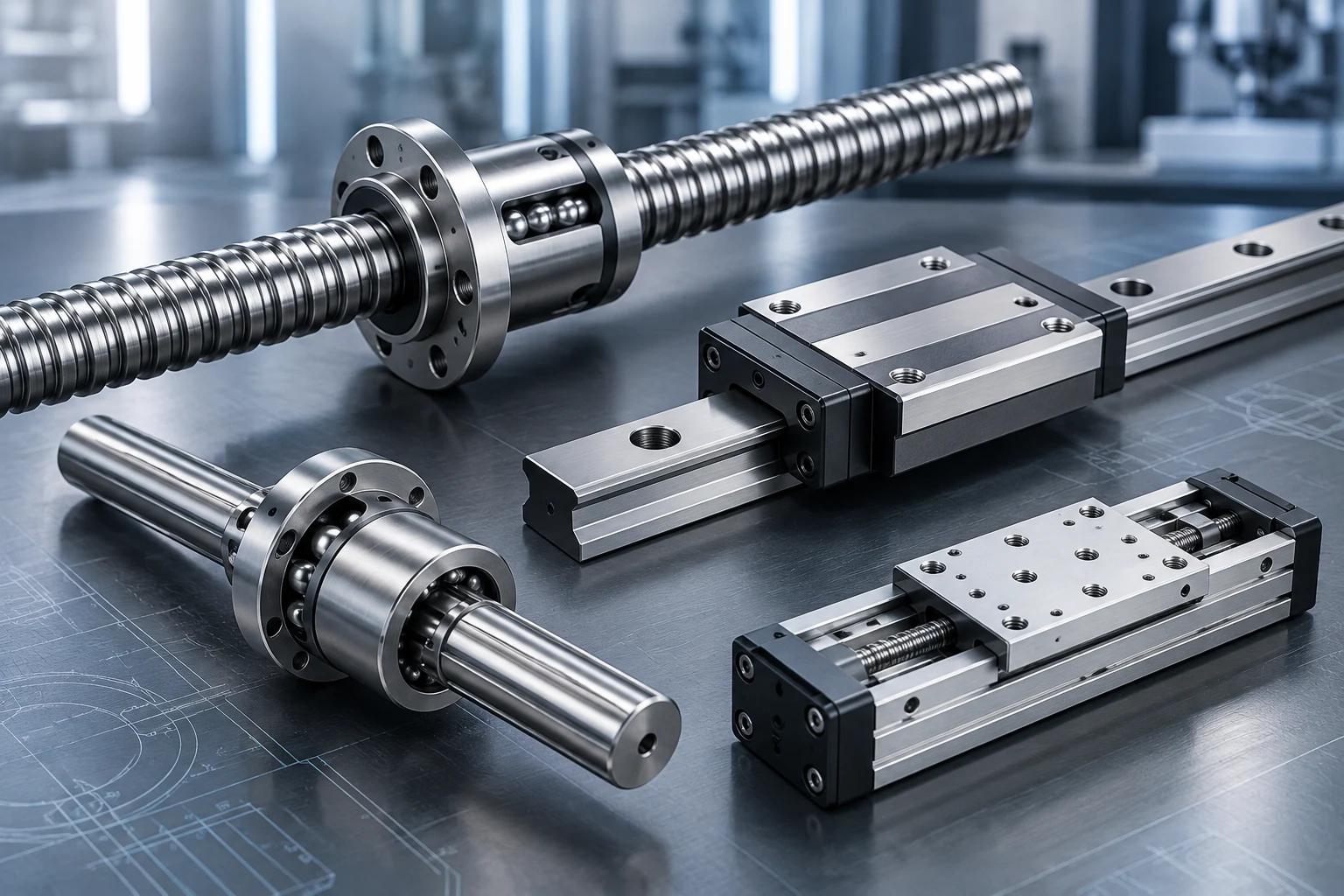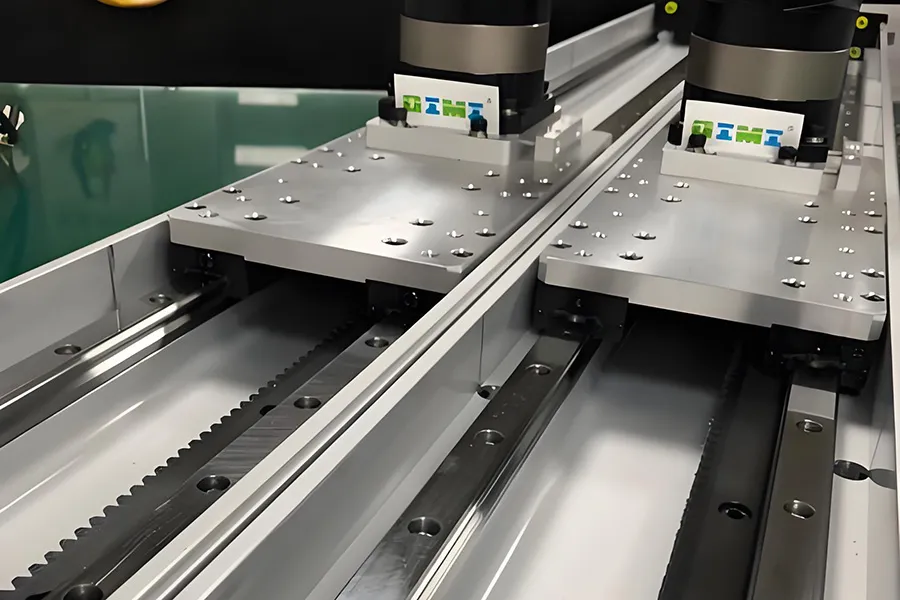
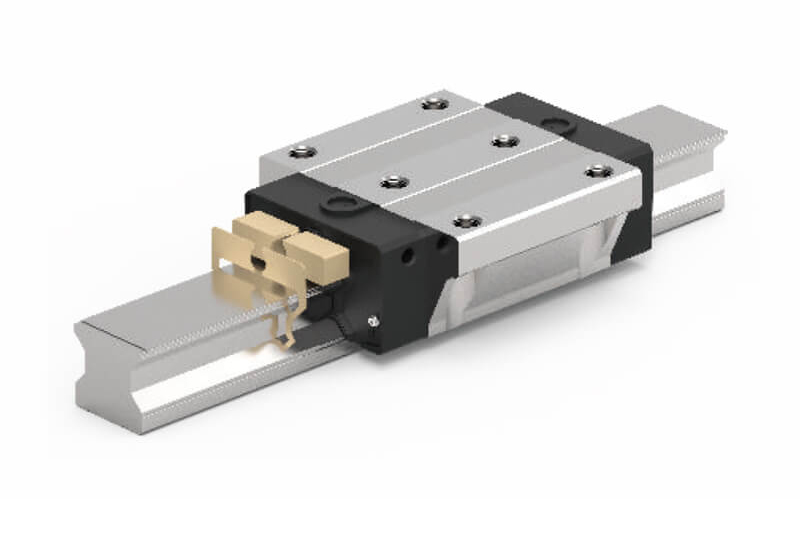
Linear guides, also known as linear rails or slide rails, are used for linear reciprocating motion. Their operating principle involves rolling elements that circulate infinitely between a slider and the guide rail, allowing the platform they support to move linearly along a predetermined path. Based on the type of rolling element, they are divided into ball-type and linear roller guides.
1. Ball-type vs. Roller-type Linear Guides
The most obvious difference between ball-type and roller-type guides lies in the shape of their rolling medium:
- Ball-type guides: Use spherical steel balls as rolling elements.
- Linear roller guides: Use cylindrical rollers as rolling elements.
They also differ significantly in load-bearing capacity, rigidity, contact method, and application areas.
1.1 Contact Form: Point Contact vs. Line Contact
Ball-type guides: Point contact. Small contact area, low coefficient of friction, high speed, but limited load-bearing capacity.
Linear roller guides: Line contact. Significantly larger contact area, more uniform stress distribution, can withstand greater dynamic and static loads.
1. 2 Differences in Load-bearing Capacity and Rigidity
The main difference between the two is in load-bearing capacity. Roller linear guides use cylindrical roller bearings in their sliders, resulting in a large contact area and the ability to withstand heavy loads. Ball linear guides, on the other hand, use spherical roller bearings, which have a relatively smaller load capacity.
1.3 Performance Differences
| Project | Ball-type linear guides | Roller-type linear guides |
| Contact methods | Point contact | Line contact |
| Load-bearing capacity | Medium | Very high |
| Rigidity | Medium | Very High |
| Speed | High speed | Medium-high speed |
| Acceleration | Medium-high speed | Up to 100 m/s² |
| Applications | High-speed motion, light-load applications | Heavy-load, high-precision, crawl-free scenarios |
2. Characteristics
As a core component of high-rigidity linear motion systems, linear roller guides possess several significant advantages:
2.1 High Load Capacity and High Rigidity
The line contact between the rollers and raceways increases the load-bearing area, effectively distributing pressure and significantly improving:
- Dynamic Load Capacity
- Static Load Capacity
- Impact Resistance
- With the same volume, the rigidity of roller linear guides is far higher than that of ball linear guides.
2.2 Higher Precision and Sensitivity
Due to minimal elastic deformation, linear roller guides maintain good motion accuracy under heavy or variable load conditions, without creeping, making them suitable for extremely demanding machining equipment.
2.3 Wide Range of Motion Performance
Due to the large total contact area of the rollers, their friction is greater, resulting in a slightly slower speed compared to ball linear guides. However, this significantly increases the rated dynamic and static load capacity. Roller linear guides can achieve accelerations up to 100 m/s², speeds up to 180 m/min, and operating temperatures from -10 °C to +100 °C. They are suitable for high-load, high-rigidity environments.
2.4 High Reliability and Long Lifespan
Reliability and long lifespan are crucial considerations for equipment. Roller linear guides utilize high-quality materials and advanced manufacturing processes, exhibiting excellent wear resistance and durability. They can operate stably in long-term industrial production environments, reducing equipment maintenance and replacement costs.
3. Typical Application Scenarios of Linear Roller Guides
3.1 Automation and Intelligent Manufacturing
As mechanical transmission components, roller linear guides can be integrated with other automated equipment and control systems to build automated production lines. Their precise motion control and positioning functions contribute to adaptive adjustment and optimization in intelligent manufacturing.
3.2 Injection Molding Equipment
Linear roller guides can withstand the high loads, high pressures, and high-frequency movements of injection molding machines, maintaining a stable mold opening/closing trajectory. These guides are commonly found in pulp and paper machines.
3.3 Material Conveying and Handling Systems
Applications such as high-speed conveyor lines, lifting platforms, and moving modules require high stability and long service life.
Summary
Ball bearing and roller linear guides each have their advantages. Ball bearing guides are suitable for high-speed, light-load applications, while linear roller guides, with their line contact structure and excellent load-bearing capacity, are more suitable for high-rigidity and heavy-duty scenarios.