In recent years, the application of artificial intelligence within the industrial sector has become increasingly widespread. From automated inspection on the factory floor to the intelligent optimization of production cycles—and now, to AI-driven programming software—people are beginning to truly feel the transformative impact of this technological wave.
Among these developments, the AI programming tool unveiled by Siemens at the 2025 Shanghai Industrial Fair stands out as a definitive focal point. Capable of generating PLC programs via natural language—complete with clear annotations—this tool compels many manufacturing engineers to confront a critical question for the very first time: Will future programming tasks ultimately be supplanted by AI?
1. What, exactly, can AI programming do?
Traditional programming by automation engineers—particularly in applications involving PLCs and robotic manipulators—typically requires engineers to perform the following tasks manually:
- Defining input and output signals;
- Writing logic control code;
- Debugging the sequence and timing of every specific action;
- Optimizing operational paths to prevent interference and collisions.
These tasks entail a massive workload and are inherently repetitive. For instance, in multi-station loading and unloading operations utilizing gantry robots, the addition of a single new station necessitates the writing of a substantial block of largely identical control logic.
2. Advantages of AI Programming in Manufacturing
The advantages of AI programming lie in the following areas:
2.1 Automated Code Generation
An engineer simply needs to describe the requirements using natural language—for instance: “Have the gantry robot pick up a workpiece from Station A, place it at Station B, and return to the home position upon completion”—and the AI can quickly generate the foundational logic.
2.2 Rapid Debugging and Modification
If adjustments are required, the engineer simply describes the desired changes in natural language again, and the AI can regenerate or optimize the code accordingly.
2.3 Intelligent Path Optimization
In complex material handling scenarios, AI leverages algorithms to identify superior operational paths, thereby reducing energy consumption and cycle times.
2.4 Assisted Fault Diagnosis
When a robot experiences an abnormal shutdown, AI can analyze operational data to suggest potential causes and recommended solutions, helping engineers quickly resume production.
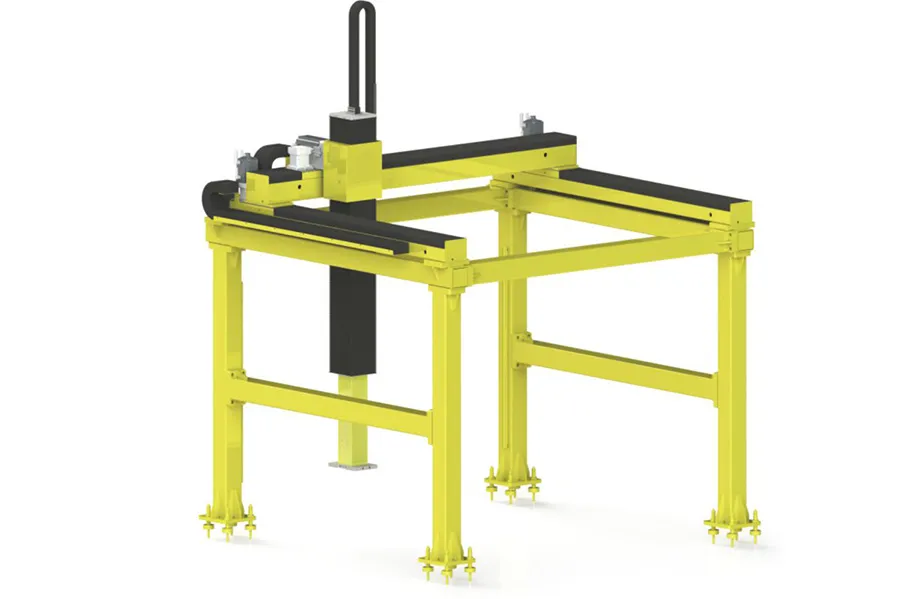
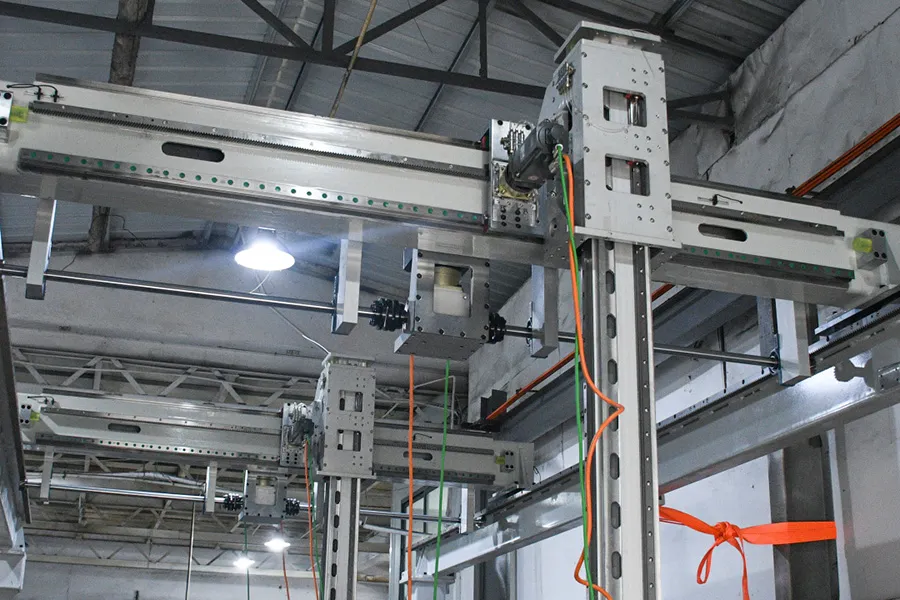
As a quintessential example of automated equipment, gantry robots are widely deployed in processes such as loading/unloading, material handling, palletizing, and assembly. Their defining characteristics include: intuitive structural design, repetitive movements, and fixed process steps; however, they often involve complex station layouts and multiple potential operational paths.
3. Application Scenarios for AI Programming in Manufacturing
These characteristics align perfectly with the key application scenarios for AI programming:
3.1 Multi-Station Loading and Unloading
On a production line, gantry robots frequently need to transport materials back and forth between multiple distinct stations.
- Traditional Approach: Engineers must manually configure coordinate points, movement paths, and operational logic one by one.
- With AI Assistance: The engineer simply describes the task—e.g., “Transport items sequentially from Station 1 to Station 5, and execute in a loop”—and the AI automatically generates the complete operational logic, capable of further optimizing the sequence based on the production line’s specific cycle time requirements.
3.2 Complex Path Planning
When a gantry robot system involves a large number of stations or covers a long travel distance, path optimization becomes critically important.
AI can integrate process requirements and cycle time constraints to automatically calculate the optimal path, thereby eliminating unnecessary waiting times and avoiding operational conflicts.
3.3 Flexible Manufacturing Requirements
Many modern factories operate with flexible order schedules, characterized by small production batches and frequent product changeovers.
AI programming enables the rapid generation of new operational programs whenever process parameters change, significantly reducing changeover times and boosting equipment utilization rates.
3.4 Equipment Diagnosis and Predictive Maintenance
AI can analyze the gantry robot’s operational data (such as motor current, travel duration, etc.) to proactively detect potential anomalies, thereby minimizing the occurrence of unexpected equipment downtime.
These capabilities elevate the gantry robot beyond the status of mere “automated equipment,” transforming it—with the aid of AI—into a core execution unit within the intelligent factory ecosystem.
4. Will Engineers Really Lose Their Jobs?
This is the question everyone is most concerned about. The answer is: No!
There are three reasons why:
4.1 AI Is Merely an Assistant; It Lacks Process Understanding
AI can generate code, but it cannot truly comprehend the underlying process logic of a factory.
For instance, in aluminum processing, should the material be clamped first or positioned first? In palletizing, which stacking pattern facilitates easier handling? Such judgments rely on an engineer’s experience, not on AI’s computational power.
4.2 Complex Problems Still Require Human Oversight
When process conflicts or sudden anomalies arise during production, AI can offer suggestions, but the final decision must be made by an engineer.
The safety, stability, and economic efficiency of a factory still depend on human oversight and validation.
4.3 A Shift in Role: From “Code Scribe” to “System Architect”
In the future, the focus of an engineer’s work will shift from “manually writing code” to “system design, process optimization, and production rhythm control.”
This type of work is of higher value and is far more difficult to automate away.
In other words, AI programming liberates engineers from “manual labor,” enabling them to ascend to a higher level of “intellectual creativity.”
5. What Does This Mean for Businesses?
For manufacturing enterprises, AI programming represents not a “threat,” but an “opportunity”:
- Shortened Project Cycles: Programming and debugging speeds are significantly accelerated;
- Reduced Labor Costs: Dependence on human labor for repetitive tasks is minimized;
- Enhanced Production Flexibility: Rapid adaptation to order changes and production line adjustments becomes possible;
- Strengthened Competitiveness: Gantry robots can be deployed efficiently and intelligently across a wider range of scenarios.
This aligns perfectly with the inherent value of gantry robots themselves: they are not designed to replace human workers, but rather to help enterprises reduce costs, boost efficiency, and enhance their competitive edge. The essence of AI programming software is no different.
Conclusion
The advent of AI programming is not intended to render engineers “unemployed,” but rather to propel them toward higher-value roles. Future competition in the manufacturing sector will not be a “contest between humans and AI,” but rather a contest of “who can best leverage AI.”
In the future, human-machine collaboration will be the dominant theme of the industrial landscape. AI will not steal your livelihood; it will simply become your most diligent and capable assistant.